

Not by itself. But with a carbon footprint similar to aviation, getting our (green) house in order will certainly help. Here’s how we can all do our bit.
Emissions from the advertising industry are much larger than most people think, says Comms Council head of sustainability Jennifer Gunn.
“Right now, the estimate is about 2 to 3% of global emissions is related to advertising – that’s equivalent to some of the larger industries that get a lot of attention around the climate crisis, like aviation.
“So we have a lot of opportunity within advertising to do our part when it comes to the climate emergency.”

Make it part of the conversation
In August 2023, Aotearoa adopted Ad Net Zero, a global five pillar framework set up in the UK, centred on the decarbonisation of the advertising industry. The Comms Council is on the steering committee leading this initiative.
The first pillar deals with operational emissions. “Before you even sell to clients, what is the emissions impact of your business? Often it’s the building, waste, travel,” says Gunn.
Ad Net Zero guides supporters to create an emissions inventory, she says. This helps them see clearly where their emissions come from and where reduction opportunities are.
Pillar two addresses emissions from advertising production, which can be measured using Ad Green or similar calculator tools.
One New Zealand’s ‘Finding Jade’ campaign is a good example of this pillar in action, says Gunn. After measuring its emissions, the telco started looking at where it could make reductions: “They carpooled or really were considerate about who needed to get to the shoot, and what’s going to happen with goods after.
“Just having that as part of the conversation, they saw some improvements over previous campaigns,” says Gunn.
“This year, we’re really looking to capitalise on the momentum around measuring emissions from the production of advertising. There’s really no reason not to start measuring the emissions from the production of a campaign.”
Normalise it
The third pillar looks at the emissions from media purchasing as well as developing the Global Media Sustainability Framework. This is an open source tool that aims to ensure emissions are measured consistently around the world.
Pillar four covers awards shows and event activations. The Comms Council has been using carbon measurement platform Trace by Isla for its own events, says Gunn.
“We started to make reductions from an awards show perspective – being very specific about the type of foods we served, for example.”
The final pillar is about using creative and the industry’s reach to change behaviour.
“So if there’s a car in the background of an advert (and it’s not a car ad), then maybe it’s an electric vehicle. If they’re unpacking groceries, maybe it’s reusable bags. If they’re drinking coffee, it’s a reusable coffee mug,” says Gunn.
The question is, she says: “How can we normalise behaviours in our advertising to put forward the image of what we need to be doing as a culture to move a sustainable economy forward?”
Everything is about carbon
Christophe Spencer, chief digital officer at WPP Media (formerly GroupM), suggests businesses start by assuming all activities have a carbon profile.
Typically, campaigns are analysed on a return on investment or cost per acquisition. Now there’s another metric: what was its carbon footprint?
Rather than labelling one media type as better or worse, Spencer says it’s more productive to focus on reducing emissions within each channel, as they all have a different lifecycle and carbon profile. For print, it’s raw materials and transport emissions, whereas out of home might require power to light screens and rotate content.
Ad Net Zero’s pillar three is becoming increasingly important as the industry realises the digital technology’s environmental impact, says Spencer.
“Digital sustainability has become a priority. While the internet feels weightless, it runs on infrastructure – data centres, ad servers, cloud computing and devices – all of which require energy.
“As we shift more budgets to digital, we’re also scaling the environmental impact – unless we actively manage it.”
He adds Aotearoa is fortunate to operate a clean energy grid, with a lot of electricity coming from renewable sources. But that’s not true in every market, says Spencer.
“If we serve an ad hosted in another region or via a CDN, that’s routed through offshore data centres, there can still be a considerable environmental impact to navigate.”
Understanding is key
There are two key areas to focus on: reporting and measurement, and ways of using technology more efficiently.
To the first point, Spencer explains it’s important to understand how an activity contributes towards emissions. “When you’ve got that understanding then it just gives really good foundations to work with from an optimisation perspective.”
He cites WPP Media’s work with Scope3, a platform that aims to provide more sustainable media solutions. It measures the associated grams of CO2 per thousand impressions served, then works with clients to optimise campaigns, ensuring they are run in the most efficient environment possible.
Being leaner with digital technology looks like using an SEO programme that makes your website run faster as well as more accessible within search results, he says. Or using lighter weight ad units – essentially smaller files.
WPP Media works with a sustainable ad server that compresses ad files using GPU and WebGl technology – on average the formats are five to 10 times smaller than HTML5 ads. This results in up to 50% lower CO2 emissions, says Spencer.
“Across these campaigns, the carbon savings equate to around one metric tonne of CO2 – roughly the same as driving a diesel car 10,000km. And that’s from creative delivery alone.
“These formats also improve ad performance. Smaller files load faster, meaning more viewability, higher engagement and in some cases – better business outcomes.”
WPP Media has been carbon tracking its digital campaigns in Aotearoa since 2022, and it now includes a carbon intensity metric in its campaign reporting. It’s a level of detail that allows them to steer clients toward more efficient partners and formats.
“We’ve seen reductions of 30% to 50% without impacting media effectiveness,” says Spencer.
Can AI be sustainable?
The rise of AI is a double-edged sword, says Spencer. It has the potential to make campaigns more efficient, optimising media plans toward more effective or lower carbon outcomes, but it also comes with a significant energy cost.
Scope3 is currently exploring how to embed sustainable AI into its platforms. “But it’s early days and the industry still needs to define what ‘sustainable AI’ actually means and how we measure it,” he adds.
“We’re open to these technologies, but only if they’re used responsibly. Like everything else in this space, it comes down to transparency and intent.”
WPP Media’s holding company, WPP, has a global ambition to become ad net zero by 2030 across all operations. Media placement emissions are over half of WPP’s total footprint, so the way it and its agencies plan and buy media is central to meeting that commitment, says Spencer.
“I think having a really ambitious goal is hugely important. It just gives something to rally around to make sure that it’s got the right level of prioritisation and focus on it within a business.”
Credible action fends off greenwashing cynicism
It’s a no-brainer for 2degrees to take sustainability seriously. Not least because its brand platform, Fighting for Fair, demands it. Customers and employees also want to see progress, says the telco’s general manager of marketing, Dave Pearce.
“It makes business sense to roll out networking equipment on our cell towers that is less energy intensive and it makes marketing sense to tell this story to inspire staff, customers and other businesses to think about their sustainability journey.”
2degrees has committed to reaching net zero greenhouse gas emissions by 2040 – a goal verified by the Science Based Targets initiative. Pearce says the telco aims to do this by reducing emissions across every part of its operations.
This includes using renewable energy across its stores, improving energy efficiency in its networks and offices and reviewing its interactions with suppliers. It also extends to transitioning to an electric vehicle fleet and allowing customers to repurpose, recycle and reuse their devices.
“We’re embedding climate impact into business decisions, from procurement to travel to the lifecycle of our products,” says Pearce.
He adds that finding the right way to communicate what the telco is up to has been a challenge recently. The prevalence of greenwashing is driving cynicism among the public towards sustainability commitments from big business.
“We knew we had to back every claim with credible, measurable action, which is why verification through the Science Based Targets initiative was so important to us.”
Earth was calling
Last year’s public installation ‘Answer the call’ was a nod to this verification. The giant melting ice sculpture was created with TBWA\NZ and placed in Britomart Square, Tāmaki Makaurau.

Inside the blocks of ice were constantly ringing phones. Earth was calling – but no one answered.
“The sculpture was aimed at stopping people in their tracks and bringing them in to learn more about what we were doing,” says Pearce.
The Advertisers Standards Authority of New Zealand has a new guidance note on avoiding greenwashing. It’s an important resource for businesses starting conversations around sustainability, says Jennifer Gunn of the
Comms Council.
“It’s about making sure that you have the best of intentions in terms of communication with consumers.
“There is a fear now of not wanting to talk about these things because they’re worried they’re going to say the wrong thing. I think it is good to err on the side of caution, but we also want to make sure that sustainability continues to be a topic that’s talked about often, that we can normalise it and keep it top of mind,” says Gunn.
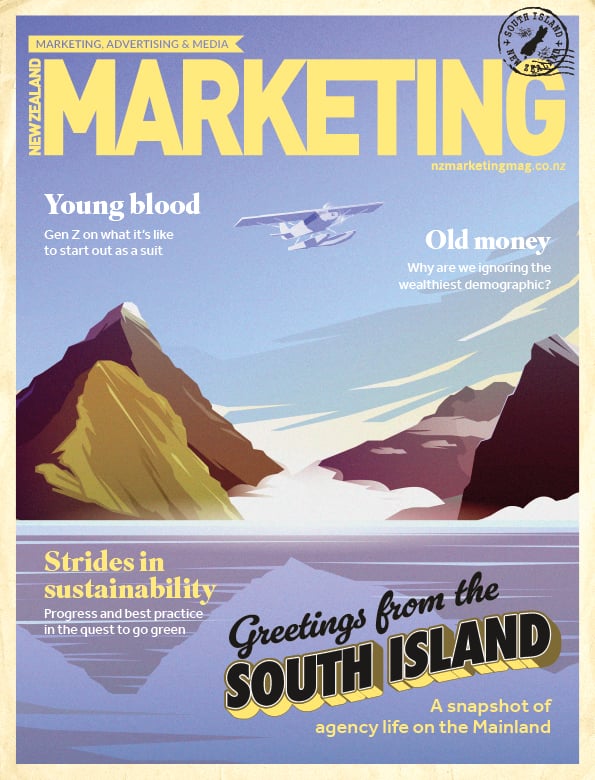
This story comes from NZ Marketing magazine issue 83, Jun-Aug 2025. Why not subscribe? Get four issues a year for just $50 (including delivery) if you autorenew.
Essential marketing intelligence. Don’t miss it.