
As the countdown to November’s general election continues, what can politicians in Aotearoa learn from campaigns overseas? And does doorknocking still work?
Like marketing, politics has always been about people, says Topham Guerin co-founder Ben Guerin. “People have always voted for people over policies.”
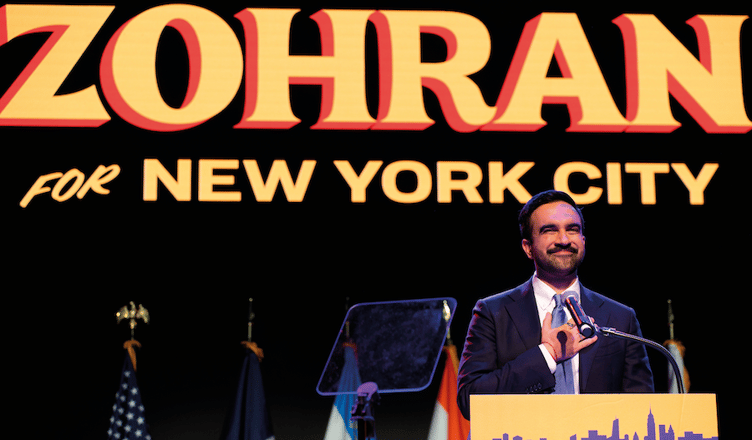
Of course, policies come into the equation, but people need to know what they’ll mean on a personal level. That’s one reason Zohran Mamdani’s 2025 mayoral campaign in New York City was so successful, he says.
The candidate’s online reach, coupled with his presence in the community, meant his name and campaign spread far and wide, from the Big Apple to Aotearoa.
Mamdani was personable and people knew what he stood for, says Guerin. “He’s not talking about geopolitical big picture issues, he was talking about reducing the price of a halal snack box. Issues that people really care about.
“You could actually make the argument that even though Mamdani’s was the most personality-driven campaign, actually it was more about policy than anything else, because he was just relentlessly focused on the cost of living and really tangible issues.”

Strong slogans
Mamdani was also consistent with his brand, uniform and messaging – all important components of a political campaign, says Guerin.
A good slogan, like ‘Zohran for NYC’, can do a lot of heavy lifting. The general rule is to encode as much information into as few units as possible.
“A good slogan draws upon things that people already believe or can instantly understand,” says Guerin. “You want to push them or pull them in a particular direction, so you’ve got to show what that direction is and show how they get there.”
Mamdani also highlights the importance of being both a skilled communicator and having substance, says Auckland University of Technology professor of communication studies Geoffrey Craig.
“It’s the paradox of running a very professional campaign in a very professionalised, modern political communication environment. But at the same time, seeming to be his own person, not just another robotic politician who repeats the party line. Mamdani cultivated a message that cut through all of that.”

Authenticity is key
People are looking for authenticity more than ever, from their favourite celebrities, influencers and brands. In politics, the stakes are even higher, says Craig.
“I think that’s the great struggle in contemporary politics, which is increasingly manufactured and controlled. So authenticity becomes a more valuable commodity for politicians.”
Former prime minister Jacinda Ardern was one example. Not just charismatic, she communicated effectively and authentically. She showed the country she was a legitimate leader, he adds.
“You can be seen to have an affinity with real New Zealanders, but you have to also be able to show the public that you have the skills, knowledge and professionalism to conduct the job properly.”
In contrast, current prime minister Christopher Luxon hasn’t been able to shake his corporate persona. “That overwhelms the ability of the public to see him as his own person,” says Craig.
Party people
It often surprises his students, but Craig says he holds politicians in high regard.
“Can you imagine a job where on a single day, you are doing a formal political interview on television, then a meet and greet at a shopping mall, then you’re doing social media posts? Politicians communicate to very different people in very different formats. You have to be a very skilled, very flexible communicator to be able to do the job effectively.”
Along with that, modern election campaigns are far more complicated than they were before, Craig adds. Fragmented media channels mean campaign managers have to tailor content to many platforms just to get their message out there.
“Campaigns have also shifted to focus increasingly on party leaders. A lot of people have been critical of modern political campaigning, saying there’s too much emphasis on performance and not enough policy reportage,” he says.
“We still do get reportage about party policies, but it’s through the primary framing of leadership performance.”
Instead of leaving it for the election period, political parties across the globe seem to be applying an “always on” approach to campaigning, Craig adds.
“The dividing line between campaigning and governing has all but disappeared. And so decisions about government are partly made with an eye to campaigning.
“Former Australian prime minister John Howard famously made a comment along the lines of, ‘When I win an election, the next morning I wake up and think, ‘How am I going to win the next election?’”
Polarising politics
Amy Errman is senior lecturer of marketing and international business at AUT. She says people are staunchly standing by their chosen parties, even if not everything they do aligns with their values. Algorithms reinforce and perpetuate the echo chamber.
“We’re starting to see this polarisation take effect – people get put into boxes and they do the same with political parties as well. We’ve lost a little bit of the common ground and understanding that it’s not necessarily about always aligning with your party.”
Normal voters share a lot of common ground, she says. “But political parties are just becoming so polarised and fragmented that I think they might think voters aren’t nuanced enough to get it.”
The politics playbook
Political campaigning follows the same playbook most brands use, says Errmann.
There are four key components. The first is ensuring the identity of the political party and its leader are clear and aligned with each other. Secondly, the campaign should appeal to the consumer’s emotions and logic, while being credible and authentic.
Sometimes, though, emotion is over-used, says Errmann. “You’ll see them highlighting the emotional aspect of a certain issue, and it goes more viral on social media. There’s heaps of studies showing hateful content that dials up people’s emotions spreads much more than something that is neutral and makes people feel good.”
Third, take a leaf out of Mamdani’s book: a consistent, cohesive message is key.
The final piece? Timing. And sometimes, that comes down to luck, says Errmann.
“Sometimes you have a certain zeitgeist. Jacinda Ardern in 2017 was a great example of people looking for someone who might’ve been slightly younger – for a politician – who had empathy. And they wanted a sunny person in the spot,” she adds.
Sometimes, a moment strikes a chord with the public. Like Te Pati Māori’s haka in parliament that went viral. “It might not necessarily be, ‘Oh, they had such a great campaign plan.’ It could be that they had a moment in time where they did something that really resonated.”
Get the basics right
To have a good political campaign you have to get the basics right, says Erin Jamieson, partner at communications and marketing agency Convergence.
She has been in the political and communications space for 20 years and says the first thing is having the right candidate.
“If they don’t have charisma, if they don’t speak well and if they don’t have a little bit of a spark, the chances are they’re not going to get elected – particularly at the national level,” says Jamieson.
It’s a sad truth, but personality, or lack thereof, can make or break a candidate’s chances, she adds.
“You might be the brightest person on the planet and the best prime minister, but you’re not going to make it because you’re not going to resonate.”
Secondly, it’s important to have a tightly managed campaign so you don’t blow the budget ahead of schedule. Fundraising and volunteers are both crucial.
Finally, it’s in how you show up. As for any brand marketing campaign, a digital presence is key, but even in this day and age, nothing beats door knocking and hoardings, says Jamieson.
“If you were doing nothing else, you still have to get your hoarding sites and you still need to door knock because people want to have a connection with a politician. Everything else matters of course, but walking the streets and knocking on doors and talking to your constituents – nothing beats that.”

Intensity and scrutiny
But what makes a political campaign different to a brand campaign? It’s the emotional intensity that comes with an election, says Jamieson.
“The intensity and scrutiny and the vilification. The campaigns become hugely personal. What I always tell my candidates is, ‘Don’t read social media.’
“Your team can do that and give you the top line stuff. Death threats are common, hate is common, it is a highly personal, stressful time.”
Vilification of candidates has increased as keyboard warriors fire off comments. Prior to the digital age, there was no way to provide instant feedback: “People could write a letter to the editor and complain, people could go to a public meeting and complain, but it was all face to face.”
Transparency and truth
This raises a number of issues. Firstly, it’s leading to fewer women putting their hands up to be part of either national or local government, says Jamieson.
“If you think about the trends that we as a society need to be concerned about, part of that is how do we actually get the best people?
“How do we actually make politics a place where the best and brightest want to be?”
For the public, another concern is how can we trust what we’re seeing in the age of AI and deepfakes, she adds.
“That transparency and truth, trying to understand what’s real and what’s not real is going to be really challenging for this election and any election going forward.”
And while people are drawn to personality and charisma, voting decisions need to be based on more than just vibes. Look what are the candidate and their party are trying to sell, says Jamieson.
Ultimately it’s a double-edged sword. People want the substance, to hear policies that resonate with them and the stage of life they’re at, but they also want to know the people behind them, she adds.
“You still have to connect. People need to know something about you. They want to know about your family. We want to have a relationship with someone on one hand, but it still should be the policies that are more important than what we think about them.”
Social stories
Craig always asks his students what they remember from the 2023 general election. Christopher Luxon’s presence on TikTok comes up every time.
“He got a lot of negative media reportage about his cringeworthy performances. But as a number of commentators have noted since, it’s about getting attention in an attention economy – and that’s what he did very effectively.”
Topham Guerin was the agency behind National’s social strategy that year. “We put a lot of thought into how we make Christopher Luxon really feel authentic and interesting on that platform,” says Guerin.
While platforms and algorithms will certainly play a huge role in the 2026 political campaign, the ones who use them effectively will gain the edge.
Guerin adds that it’s easier than ever for more people to create high-quality content.
Digital tools and AI have developed to the point where people can build dashboards from spreadsheets – there’ll be more mini-campaigns from the parties but also from concerned individuals, he says.
“You can imagine a world where a politician announces a policy in the morning and there’s already an interactive calculator spun up by a random member of the public that afternoon, based off that policy document.
“Politicians and their press teams will have to be really careful about how they respond in that space. I think it’s easier than ever for normal punters to analyse data and make that data accessible.”
More knowledgeable citizens
Fragmented media channels also mean people don’t get the full picture when they’re scrolling, says Errmann. The leaders debates are still televised, but most people will end up only seeing the highlights that make it to social media, she adds.
“Social media is turning the way we look at political parties into entertaining soundbites that live short-term in our memory. You might see Winston Peters get into a big argument with someone and you’ll see the top five moments, and then the next day you’ll forget.
“You have to be rational and sensible and go searching yourself, which for the average person, how much time do they have to do that?”
Craig says a positive feature from social media is the rise of explainer content – in which creators break down complicated topics for their audiences.
“It does reach people who would not otherwise be politically engaged, and it does help in making people more knowledgeable as citizens.”

This story comes from NZ Marketing magazine issue 86, March-May 2026. Why not subscribe? Get four issues a year for just $50 (including delivery) if you autorenew.
Essential marketing intelligence. Don’t miss it.