

Every month the Together team highlights five media stories from New Zealand and globally that defined the month, and one great media idea we love. In March, we cover attention’s impact, shifts in readership behaviour and engagement, the risks of relying on emerging AI platforms plus a fun response to breaking news from KitKat.
The cost of dull media – attention is not optional
Dr Karen Nelson-Field’s latest paper, The Eye-Watering Cost of Dull Media, published in March, puts a concrete number on something the industry often talks around: most media simply isn’t working hard enough.
The research argues that low-attention environments systematically destroy effectiveness, with campaigns in dull media requiring significantly higher spend to achieve the same outcomes as those in high-attention contexts. In simple terms, cheap reach can quickly become expensive reach.
This builds on a growing body of evidence linking attention to business outcomes. The paper highlights that even small gains in attention can drive disproportionate improvements in recall, brand lift and ultimately sales.
What this means for NZ marketers:
- CPMs are an incomplete metric. A lower CPM in a low-attention environment may deliver worse ROI than a premium placement that people actually notice.
- Creative and media are inseparable. Strong creative cannot compensate for poor attention environments, and vice versa. Planning needs to consider both together.
- Context is back in focus. High-attention channels such as premium video, news environments and certain OOH formats should be viewed as effectiveness multipliers, not just cost centres.
This is not an argument to abandon efficiency, but a reminder to redefine it – something we strongly support. At Together, we believe that the goal should not be the cheapest impressions but the most effective ones.
Read more: amplified.co/resources/cost-of-dull
Nielsen readership results – what’s actually changed year-on-year
Nielsen’s latest readership results released in March show a market that is not so much growing as reshaping. The topline headlines remain positive, but the more interesting story sits in how audiences are shifting compared to last year.
At a portfolio level, Are Media’s monthly reach of 1.9 million is stable, with NZ Woman’s Weekly edging up to around 430,000 readers per issue, while Woman’s Day has held relatively steady in the mid-300,000s. This continues a trend we’ve seen across 2024 into 2025: resilience in habitual, identity-led titles, particularly among female audiences 35+. Stuff’s results show a more pronounced shift. Its acceleration of digital subscriptions, now up more than 50%, is significant.
Compared to previous data, three changes stand out:
Print decline has stabilised at the top end. While long-tail and regional titles continue to face pressure, flagship brands have either held or slightly grown readership. This suggests a “flight to quality” effect, where remaining print readers are consolidating around trusted, premium titles.
Digital is central. Publisher narratives have all shifted from defending print to promoting total audience. In 2024, print angles still dominated their stories. Into 2026, digital scale and subscriptions are leading a “total audience” story.
Engagement is becoming an even more important metric. Subscription growth, time spent and repeat readership are increasingly being used as proxies for value. Reach alone is no longer enough, particularly as duplication across platforms increases.
For NZ marketers, this reframes how to use Nielsen data.
First, treat print as a high-attention layer rather than a mass reach driver. The audiences are slightly smaller but more engaged and often more commercially valuable.
Second, lean into total publisher ecosystems. The combination of print, digital and logged-in audiences offers better opportunities for frequency management and first-party data targeting.
Finally, be cautious with year-on-year comparisons within the Nielsen data. Growth is uneven and often concentrated in specific titles or audience segments. The real opportunity lies in identifying where attention is consolidating by audience, not just where reach is increasing.
OpenAI shuts down Sora amid strategic rethink
In a surprise move, OpenAI has pulled the plug on Sora, its AI-powered video generation tool, just three months after signing a high-profile $1 billion content licensing deal with Disney. The closure signals a significant strategic pivot as the company tightens its belt ahead of a potential IPO.
Cost appears to be the primary driver. Generating AI video is exponentially more expensive than processing text queries, and with OpenAI planning to spend upwards of $100 billion over the next four years while targeting triple its current $13 billion revenue, cutting resource-heavy projects has become a priority. The speed of the decision raised eyebrows, Sora’s closure was announced just one day after OpenAI published guidance on using the tool safely.
The move reflects intensifying pressure from rivals. Anthropic is growing faster among high-value corporate users, Google remains committed to its competing video tool, and an IPO race between the two AI giants is quietly accelerating.
What this means for NZ marketers:
Sora’s abrupt end is a reminder that AI tools, however dazzling at launch, remain vulnerable to commercial reality. Brands building creative and media workflows around emerging AI platforms should factor in stability risks before going all in.
Read more: nytimes.com/2026/03/25/business/dealbook/sora-openai-finances-ipo.html
Apple opens up maps to advertisers
Apple is entering the location-based advertising arena, announcing plans to roll out ads within its Maps app for US and Canadian marketers from this summer. Ads will appear through the app’s search function and a new Suggested Places feature, putting Apple in direct competition with Google Maps, which has offered similar inventory for years.
The move is part of a broader Apple Business platform launching in April across 200+ regions, connecting businesses with consumers across Maps, Mail, Wallet and Siri. It reflects Apple’s growing appetite for advertising revenue, which hit an all-time high in Q1 2026 as overall services revenue reached $30 billion, up 14% year-on-year.
Crucially, Apple is leaning into its privacy-first positioning. Location data and ad interactions won’t be tied to individual accounts, and no personal data is shared with third parties, a meaningful differentiator in an increasingly privacy-conscious market.
What this means for NZ marketers:
The immediate opportunity is limited given the US and Canada launch focus. However, with the Apple Business platform rolling out globally in April, local businesses, particularly in retail, hospitality and tourism, should move quickly to claim their Maps listings now. With over 1.6 billion iPhone users worldwide and strong iPhone penetration in New Zealand, this channel could become highly relevant, and sooner than expected.
Read more: marketingdive.com/news/apple-rolls-out-ads-for-maps-as-advertising-revenue-grows/815613
Reddit builds a shopping layer from community trust
Reddit made its most significant commerce move to date in February, and it’s one worth watching closely, particularly for brands in considered purchase categories.
The platform announced it is testing a new AI search tool that takes community recommendations and matches them with products from some of the company’s shopping and advertising partners. When users search for something like “best noise-cancelling headphones,” they will see a carousel of related products at the bottom of the results, featuring products directly mentioned by users from conversations on related posts and comments.
Reddit has long been a word-of-mouth engine, users routinely add “Reddit” to their Google searches to find authentic peer reviews. The platform is now attempting to formalise and monetise that behaviour without abandoning the trust that created it. The audience growth backing this move is real: weekly active users for search jumped 30% over the past year, from 60 million to 80 million, while their AI-powered Reddit Answers feature grew from one million weekly users in Q1 2025 to 15 million by Q4.
What this means for NZ marketers:
If your products are discussed on Reddit, in tech, finance, outdoor, gaming, home or health categories, those conversations are about to become purchase pathways. Start listening now: what are communities saying about your brand? Earning organic mentions in those discussions will matter just as much, if not more than, simply buying placements.
Read more: techcrunch.com/2026/02/19/reddit-is-testing-a-new-ai-search-feature-for-shopping/
Campaign we love: KitKat (and the internet) turns a theft into a moment
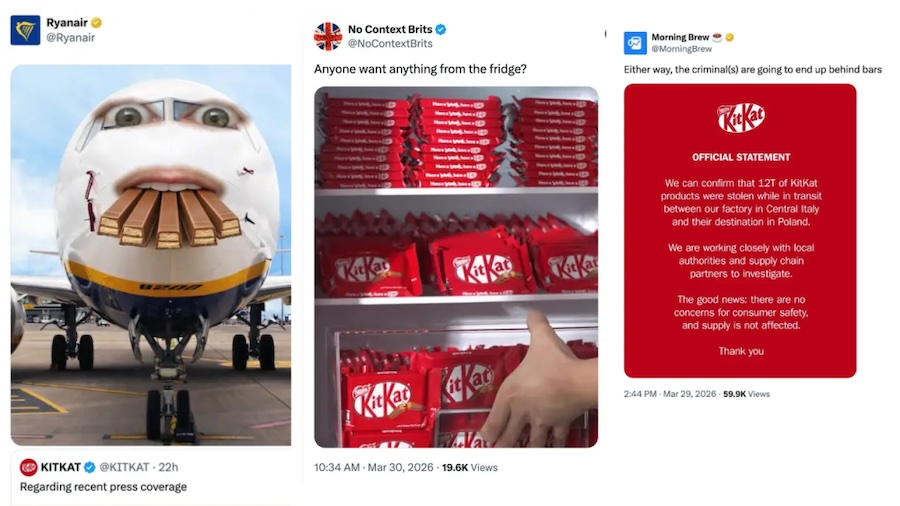
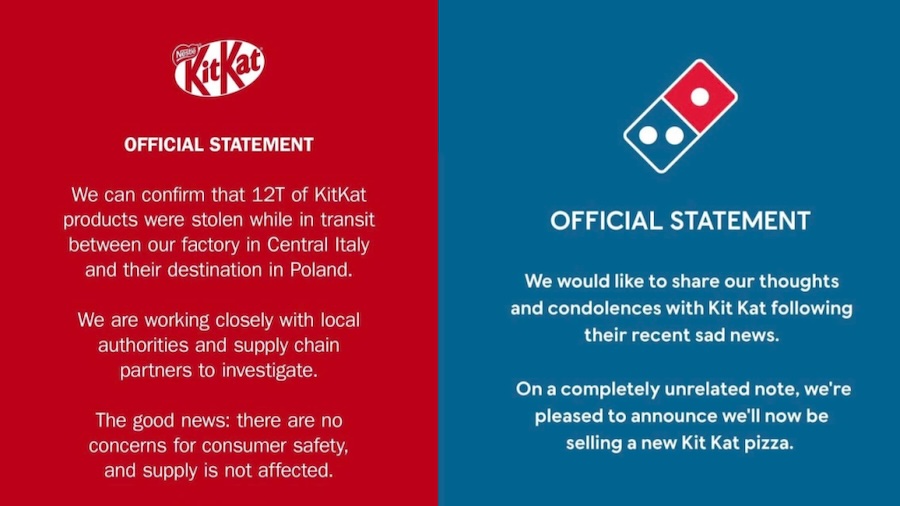
When news broke of a mass KitKat theft in Europe, the internet did what it does best: piled in with jokes, memes and commentary. Several brands had fun by suggesting they may have been involved with the theft, from Ryanair to Dominos, sparking huge social momentum and turning a negative story into an expression of brand affection. Nestlé moved quickly to join the conversation too with a simple, on-brand response that reframed the story as a playful “have a break” moment.
Why we love it
- Speed over polish. The effectiveness came from reacting quickly and natively, not crafting a perfect asset.
- Brand consistency. The response felt unmistakably KitKat, reinforcing one of the most enduring brand platforms in the category.
- Earned-first thinking. By tapping into an existing news moment, and engaging with the responses, all brands generated reach and engagement far beyond what paid media alone could achieve.
For NZ marketers, it’s a useful reminder that not all impactful media requires large budgets or long lead times. Cultural agility, paired with a clear brand platform, can turn unexpected moments into disproportionate impact.