


Independent brand strategist Mike Pepper on why many marketing strategies don’t go according to plan, and how structure and innovation work hand in hand.
Output, output, output – flat out, day in, day out. Too often this is the reality of being a solo marketer or one of a small team. It leaves little bandwidth for big picture thinking.
But without strategy, your activities risk just being a collection of disjointed promotions. Strategist Mike Pepper launched Industry Brands earlier this year after more than two decades in the space. He sat down with NZ Marketing to talk about making brand strategy relevant and getting buy-in from your business.

NZM: Let’s start with a simple-sounding question: what is strategy?
Michael Pepper: I see a couple of different versions of strategy out there. I see ‘brand on a page’ strategy, which is: what do we stand for – the enduring brand platform. It’s often written as a brand on a page, and can get lost in the urgency of a short-term creative process or parts of the business not aligning with those ideals.
The other one is the marketing plan or strategy – activities over a calendar year or 18 months. This can change almost monthly as the demands outside of marketing impact its mandate or focus.
So you can end up measuring yourself against a list you didn’t achieve because the business demands changed. The brand on a page is a section in a brief, not a definitive criteria for evaluation. The marketing plan becomes a calendar of events that didn’t happen the way you’d planned.
NZM: Which feels like a fail, right?
MP: It can feel like a fail, but actually it’s marketing fulfilling its traditional role of servicing the dimensions and chaos of the rest of the business.
Marketers have to understand every other part of the business, but the rest of the business doesn’t really need to understand them. And sometimes other departments almost take joy in poking fun at the parts they don’t understand about marketing. That’s when you hear it’s about colouring in.
Marketers have a responsibility for helping shape and make other parts of the business customer-centric, but they don’t always have the authority or the accountability.
Strategy is about asking: what’s the structural stuff, the enduring stuff, how do you govern and maintain brand across every touch point?
That can sound boring – frameworks and structure – but it isn’t a choice between brand maintenance and innovation.
Everyone gets really excited by innovation and newness and novelty. And they might see maintenance as dull, or even in the way of innovation. But maintenance is not the enemy, it’s actually what sustains innovation. Otherwise you just get novelty. If you build something innovative, consistently building on that adds value to the organisation.
Being consistent actually is the strategy. Turning up and maintaining and being there in a way that’s on brand.
Does marketing need a rebrand? Read more from the colouring-in issue here






NZM: Where does creativity fit into all this structure?
MP: No one’s saying: “Let’s not be creative.” But you’re going for creative consistency – consistency at a highly creative level – so you’ve got to combine the two: maintenance and innovation.
Because of the way marketing teams have to respond to the business, consistency is really, really hard. They’re having to deliver on other people’s needs. And also other people are running off and creating their own things.
But you’re not going to get consistency from other departments by going: “Well, here’s our marketing plan.”
Because they’re like: “I don’t care about that. I’ve got to deliver to these specific objectives and timelines. How are you going to sync in with that rhythm?”
That’s where freedom within a framework works as an idea of what strategy is.
Fundamentally, it’s who we’re going to go after and how we’re going to solve their needs.
NZM: So strategy is the framework. What are the tools you use within that? It’s more than just brand guidelines, isn’t it?
MP: Correct, 100%. Yep, yep.
I think marketers essentially have two buckets of skill sets. One is the innovation skill set. So there’s the provocateur – seizing cultural moments and piggybacking on those or bringing energy into the business to help it have a sense of momentum.
But the others, we’re all much more around tools that allow us to look ahead. Because the great thing about the marketing department, and brand teams, is they can visualise the future.
So you can map out scenarios: if we went down these paths, what would they look like? How would that feel? What would be the products and services? How would we arrange those within our brand?
And so for me, it’s not brand guidelines. It’s presenting an inspiring view of the future we all can work towards. That can be spoken or visualised, but it’s got to be repeated over and over again. And the main thing is it’s got to feel like it’s an organisational vision, not a marketing strategy.
Marketers need to set the vision and say: “This is where we’re heading as an organisation.”
NZM: How do marketers bring the rest of the organisation along?
MP: They do that by making the vision seem really, really attractive. It’s the same thing you’d want to do with a consumer. So internally, you’ve got to come up with a way of articulating the organisation’s purpose and goals – strategy – that feels like it’s aligned to brand and aligned to people and culture. Make that triangle start working and feel like a narrative. Marketing teams are narrative teams, so that should be their sweet spot.
One idea, one purpose, one positioning. The more clear you are, the more focused you are. And then repeat, repeat, repeat.
The other one is: pay for things. Hold up your really attractive view of the future, and say: “Want some of that? Come through us, we’ll give you the tools, we’ll be involved. It’ll be fun, and at the end you’ll get a better result than if you just do it yourself. And we’ll pay for some of it.”
You’ve got to put crumbs out to get the ducks to come to the pond.
NZM: If you’re busy with day-to-day operational stuff, how do you find time to do strategy as well?
MP: Lean on your partners. If you’re a marketing manager, you can get caught up in the machine. But an external point of view can be great at bringing tools to the table and support for C-suite or board conversations.
External help might come in once every 10 years and do a really sound, solid reset of foundational stuff: what you stand for, what’s the long-term view, who you’re going after.
You also have to work with people around you. Find people within the executive team who think as marketers, and say: “Let’s be the long-term thinkers.” Then use that partnership as your superpower.
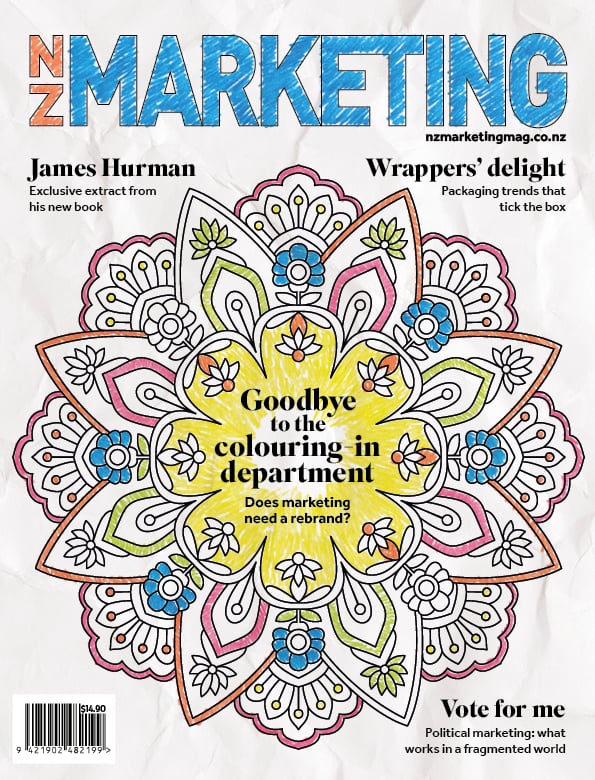
This story comes from NZ Marketing magazine issue 86, March-May 2026. Why not subscribe? Get four issues a year for just $50 (including delivery) if you autorenew.
Essential marketing intelligence. Don’t miss it.