


Regional reporting is the lifeblood of the media industry. It does more than just feed the news machine, it binds communities together.
“News is a public good funded by a commercial model.” That’s how Grant McKenzie, CEO of Allied Press, sees it.
In recent years, much has been written about the commercial side of journalism, a business model that sits somewhere between vulnerable and endangered. We know the recent casualties. Fair Go. Newshub. Dozens of community newspapers. But has enough been said about journalism’s essential function as a public good that keeps communities informed and connected?
Allied Press, soon to be Allied Media, has 163 years under its belt. The Otago Daily Times was the country’s first daily newspaper when it launched in 1861. Today, Allied Press publishes more than 20 newspapers across the South Island, it runs five magazines and major local events. It’s behind ODT.co.nz, the online news platform for the South.
Allied’s local structure sets it apart. It employs 95 journalists across the South Island, from Blenheim to Invercargill. While many regional publications are centralised, it’s still on the ground and in the towns.
“The South is our home. We know our patch and are committed to its wellbeing,” says Paul McIntyre, Allied Press editor in chief. “This means we have the connections, the understanding and the motivation to get to the heart of the matter quickly, accurately and authentically. And because we have an ongoing, longstanding presence, we are seen not as interfering outsiders who only turn up when something goes wrong, but as locals with a track record of celebrating the good that happens as well as asking awkward but important questions.”

Got insight? Let’s talk about it on LinkedIn.
Local journalism plays a vital role in democracy, holding people and organisations to account, as well as celebrating achievements. Reporters are often the only independent, non-government entity with the time and resources to discover and share what is going on within a community.
“We give people information they want and need to make informed decisions in their own lives. And to be active participants in the organisations and events that shape their communities,” explains McIntyre. “We help people express their concerns and fears, celebrate and mourn, understand events that affect them and collectively consider their futures. In these ways, we help create better informed citizens, foster more strongly connected communities and protect the integrity of the institutions on which they depend.”
But with declining advertising revenue, we cannot take journalism for granted.
Google and Meta now take over half of New Zealand’s advertising dollars. This shift in spend has left a significant void in the budgets of media companies across the country.
“The viability of journalism is at stake,” says McKenzie. “More dollars go to overseas companies that do not invest in news coverage but rely on the news to provide revenue for their business.”
What’s at stake
We’ve seen the results first-hand. The Spinoff reported that the number of journalists in Aotearoa had fallen from more than 4,000 in 2006 to just 1,674 in early 2024. It’s an alarming trend with consequences that extend far beyond the media industry.
McIntyre is blunt: “What’s lost when local reporting disappears? Nuance, understanding, cohesion, integrity, democracy.”
McKenzie agrees. “Our stories will not be told, our officials will not be held to account and the voice of the community will be lost.”
The US provides a cautionary tale. Over there, one-fifth of the population lives in a news desert – a community with one or no local newspapers. Evidence from America shows that an absence of local journalism leads to lower voting rates, greater polarisation and increasing corruption.
Preventing New Zealand from going down that path should matter to anyone who buys media, from in-house marketing teams to agencies.
All of this raises an important question for marketers: if we say we value local journalism, why aren’t we backing it with our media budgets?
Supporting local journalism isn’t just the right thing to do. Alongside print, news sites offer a brand-safe, trusted online environment with, in many cases, greater engagement than social.
There is a future for local journalism. But only if we invest in the media that invests in New Zealand.
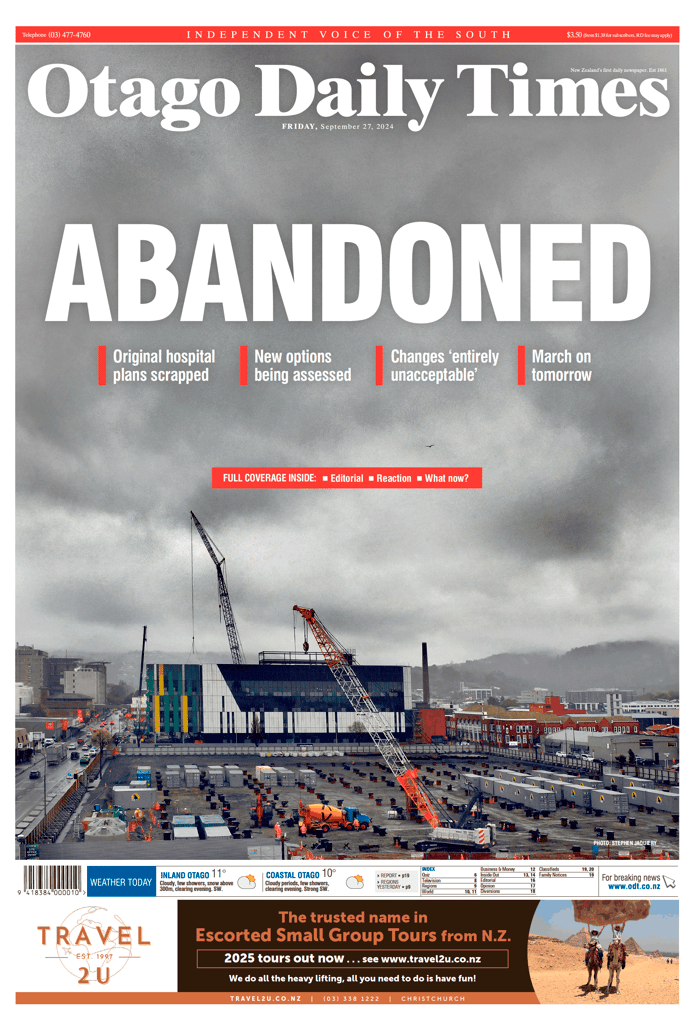
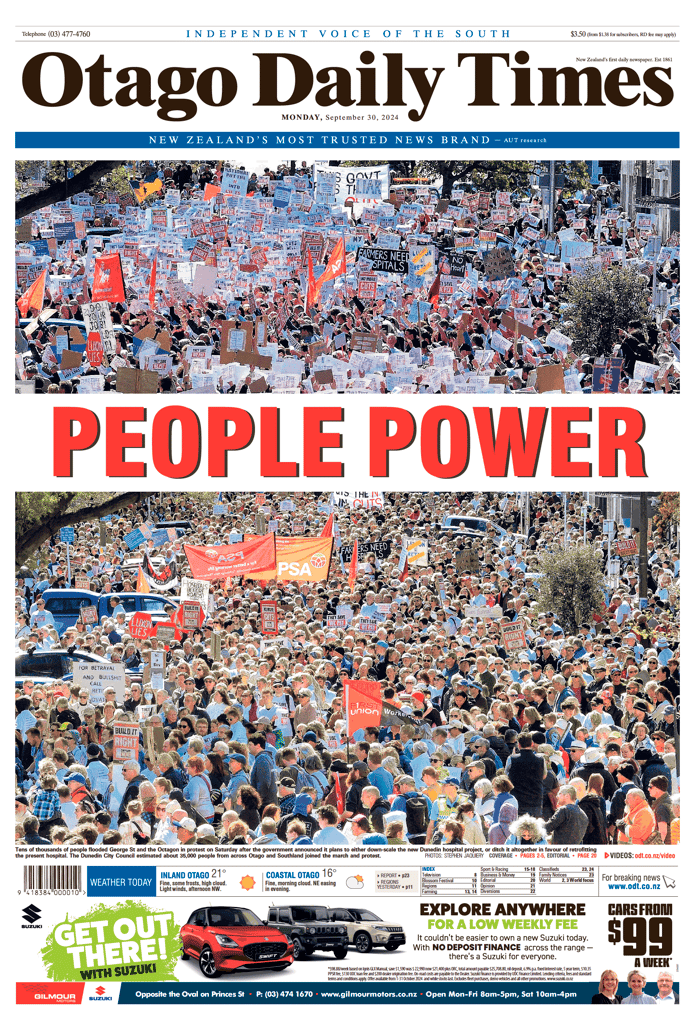
Otago Daily Times exposes hospital cuts, forces government backdown, wins Voyager
Last year, Otago Daily Times’ reporting about cuts to the new Dunedin hospital project led to 35,000 people marching on the streets. It helped force a government backdown and won Best Editorial Campaign at the 2025 Voyager Awards in May.
While the government maintained a wall of silence, exclusive reports uncovered what was really going on behind the scenes.
Multiple inside sources trusted ODT journalists, and the paper acquired an internal document showing the government was investigating cuts to beds and operating theatres.
Continued reporting exposed secret plans – including cutting an entire floor – and heaped more pressure on the government.
The ODT’s campaign drove the conversation and informed, motivated and mobilised the southern public. Hundreds of stories reported the views of clinicians, politicians and ordinary people.
Over the last four months of 2024, the new hospital made the front page 45 times. Most stories were exclusives and were free to read.
Eventually, in the face of public pressure, new health minister Simeon Brown came to Dunedin in February 2025 and announced the most severe of the cuts had been abandoned.
This story comes from NZ Marketing magazine issue 83, Jun-Aug 2025. Why not subscribe? Get four issues a year for just $50 (including delivery) if you autorenew.
Essential marketing intelligence. Don’t miss it.