


They’re New Zealand’s wealthiest cohort, but are advertisers missing the mark with over-55s? We examine how to connect with this crucial audience, and what to do about the ad industry’s ‘ageism’.
If you don’t know how to market to over-55s, it’s going to get increasingly difficult to succeed in business in New Zealand.
As of June 2024, New Zealand already had around 1.5 million people aged 55 and up, accounting for about 28% of the total population. And the proportion is tipped to rise over the next few years.
They’re also a wealthy group: according to the most recent Stats NZ data from 2021, the median individual net worth was $363,000 for ages 55-64 and $424,000 for 65 and over, compared to just $34,000 for ages 25-34.
And experts warn that the marketing industry needs to change how it operates, if it is to connect effectively with the growing number of older New Zealanders.
Ad industry ‘ageism’
One issue the industry needs to address is the disappearance of people in that age group from agencies, according to Art of the Possible’s ANZ director Adam Brami.
His business model deliberately leans into senior specialists and proven category expertise, favouring those who’ve been around long enough to know what works and what doesn’t.
Brami sees a clear lack of over-55s in the industry outside of executive roles, which can be classified as “good old-fashioned ageism”, although he says the reality is more layered than that.
“Decisions around headcount are rarely made with malice, but almost always through the lens of protecting profit margins and delivering year-on-year growth forecasts that are expected to climb, regardless of external conditions,” he says.
“When something’s got to give to preserve shareholder returns, it’s rarely the executive leadership, the juniors or the cultural mainstays in the engine room. It’s the over-50s, those further along in their careers, higher up the pay scale and often not considered part of the future-facing narrative,” he says.
“We proudly promote campaigns that celebrate inclusion across race, gender and identity. But when it comes to age, particularly those over 50, the silence is deafening.”
Who’s making the ads?
As Brami points out, the people making the ads are often decades younger than the people they’re trying to reach.
“When the median age of the country is 38, and the creative team’s average age is 26, it’s no wonder we miss the mark. It’s not just tone-deaf, it’s a generational mismatch that leads to cliched, patronising work that doesn’t reflect the lived experience of the audience.”
Brami says pushing out more experienced people not only makes it harder to get into the heads of older consumers, but also impacts the performance of agencies in general.
“There’s a reason people don’t hire fresh grads to build their houses. They want master builders – people with a portfolio of solid, proven structures.
“It’s the same with commercial pilots: you don’t want the one who just passed the exam, you want the one who’s logged thousands of hours and landed safely through turbulence.
“Other industries value experience. They trust it. They seek it out. Yet in advertising, speak to anyone over 50 and they’ll tell you – quietly, if not openly – they often feel invisible, patronised, or sidelined.
“As if experience is a threat, not a strength. Although it’s often exactly this kind of experience that agencies quietly call upon to steady the ship, the trusted pair of hands brought in to get a campaign back on track when nothing’s landing. It’s valued… just not always retained.”
Experience counts in PR
While the ad industry might have a problem with ageism, the same can’t be said for PR, says industry veteran Kelly Bennett. He’s the founder and managing director of One Plus One Communications.

“Advertising is not an industry that rewards grey hairs at all. It’s predicated on the newest, the shiniest, the thing that captured the zeitgeist the most. And that is not old people.
“Whereas in my industry, I feel that lived experience is a good thing to add to the mix. When you’re advising companies, the ability to live through periods of time, take learnings from it and then share those up by way of advice, that’s useful.”
Media consumption habits have changed in recent years, but pitching stories to mainstream media platforms is still an effective way to reach over-55s, Bennett – a recent new member of that group – says.
“When I do media training with corporates, I start by holding up my phone and inviting people in the room to tell me what their media consumption habits look like.
“I will wake up and the first thing I do is look at some apps. I have RNZ national, Stuff, Spinoff, the Telegraph, the Guardian and CNN. But I’m in the media game, so that’s a bit skewed.”
However, many of his clients who don’t work in media have none of these apps, doing most of their online news consumption via TikTok, Instagram or Meta. “And they still rely on getting their news from radio or the six o’clock news.”
Traditional tastes
Sam Brough, brand lead at brand tracking specialists Tracksuit, says Kiwis aged 55+ tend to favour more traditional media channels. TV is the most popular (used by 77%), radio comes in second (62%) and online newspapers rank third (49%).
“While 74% of the demographic use Facebook, Kiwis over the age of 55 are significantly less likely than the national average to consume social media channels like TikTok and X [formerly Twitter],” he says.
“Based on this data, we’d recommend brands looking to target older demographics should focus their marketing and brand spend on traditional broadcast media, like television and radio and targeted digital outlets.”
However, he says this is a macro view of the 55+ demographic within New Zealand and it’s worth keeping in mind that the insights will vary from category to category.
“It’s important to always have a balanced mix of advertising. Regardless of the maturity and stage of the business, marketers always have two jobs to do: build future demand for the brand among consumers not looking to buy right now, and harvest existing demand by efficiently acquiring customers who are in-market for purchase today.”
Brough says research shows that, when looking to create future demand (to drive brand and long-term growth), broadcast channels (TV, radio, outdoor, print) “work much, much harder”.
Tracksuit analysed more than 4,000 brands across hundreds of categories and found that 92% of categories have fewer than three brands in their consumers’ consideration set at any one time.
“That means getting on the consideration list among all category buyers should be top of the marketing agenda and depending on the brand, targeting the ever-growing 55+ age group in NZ may be a smart way to do just that.”

Turning on TV
TVNZ chief revenue officer Valerie Walshe says television, both broadcast and digital, is a mass-reach medium.

“While we have a large number of viewers between 18 and 54, we also have a sizeable, highly engaged 55+ audience making up a third of our viewership – depending on the platform channel or piece of content,” she says.
“This group is loyal to broadcast TV – they’re consistent TVNZ 1 watchers! But they’re increasingly showing up on TVNZ+ too.”
Walshe says there’s powerful data on television’s reach for the 55+ demographic, with research showing 86% of 55+ are watching TV every week.
“It is by far the most effective medium for brands to engage with this age group. It’s also a demographic that is fast growing. According to Stats NZ, the percentage of the population aged 65+ is projected to increase to approximately 19-20% by 2030.
“It’s really important advertisers don’t overlook 55+. Seventy is the new 50 – they are still earning and they are still spending, and they make a huge contribution to NZ’s economy.”
As the 55+ demo increases, we all need to recognise the value of this group and look to reach them with content and advertising that’s bespoke and that resonates, Walshe says.
“Recent research from ThinkTV shows this group are ‘big spenders’ in key areas – they account for a third of all grocery spending and 60% of flights and accommodation spending.
“Smart marketers should be thinking about this group strategically, given their ability to generate sales and contribute to business success.”
The power of ‘word of mouth’
While media platforms like radio, TV and print are still great ways to get your message out to the over-55s, some brands are finding success reaching this age group with more digital-focused campaigns.
Over-55s are a key demographic for sports travel, hospitality and fan events specialists STH Group, who do travel and hospitality packages for the All Blacks and the Black Ferns.
Nick Rowland, head of marketing and product development NZ for STH Group, has two main reasons why older Kiwis are vitally important customers for their business.

“Disposable income is number one. Obviously, if we can try to target clients that have dollars in the bank, it’s helpful for us.
“Number two is that they have time on their hands. When we went to the Rugby World Cup, some fans travelled for eight or nine weeks around France. You can’t do that with an annual leave balance.”

Got thoughts? Let’s talk about it on LinkedIn.
Rowland says STH’s marketing has shifted towards social media – particularly Facebook and Instagram – as well as SEO.
“If you are in the older demographic, you’re still using a phone or a laptop to do some research. People are going to type in, ‘All Blacks hospitality’, so search can be quite powerful.
“Email marketing is another powerful tool for us. When an email pops up from the All Blacks and it’s a team naming or something about the Black Ferns playing this weekend, customers will open it.”
Rowland says over-55s are all about the experience, and a big part of their marketing approach is to enable their customers to storytell for the brand.
“It’s traditional word-of-mouth marketing – giving our customers the tools to enable them to post about their own Argentina experience while on tour with our brand is really powerful, because next time 10 of their mates are going to want to do the same thing.”
Diverse group
Over-55s are also important for the retail sector. Juanita Neville-Te Rito, founder and managing director of retail marketing consultancy RX, warns against seeing them a single cohort defined by age.
“Some retailers are doing it well, especially those who focus on service, trust and quality over trends. But many still fall into the trap of stereotyping,” she says.
“Over-55 doesn’t mean ‘old’ it means ‘lived experience’ and it can mean still working, tech-savvy, socially engaged and very brand-conscious.”
Women in this age group are especially important to reach. Neville-Te Rito says they are the most influential, under-recognised consumer segment in the country.
“Women over 55 are the economic engine room of many Kiwi households. They are the CEOs, CFOs and COOs of the household. They influence or directly control the majority of spending decisions from groceries and gifts to travel and family finance.”
She names Karen Walker (which broke ground years ago with campaigns featuring women in their 60s, 70s and 80s), Moochi, Kowtow and Untouched World as fashion brands doing well with this audience.
“The 55+ consumer of today is not some saggy, grey caricature of the past. She could be running a business, training for her third half-marathon, planning a trip to Tuscany or mentoring the next generation. She’s stylish, smart and self-assured.
“She’s not fading out, she’s dialling in. And if your brand still thinks she’s invisible, it might be time to check your lens.”

Society-wide challenge
The challenges created by New Zealand’s ageing population are not unique to the advertising industry, according to Lot Hawkins, founder of the Stella Collective.
Hawkins has a background in qualitative research. She launched the collective with a focus on women over 45 but pivoted to a more general theme of longevity.

“That moved my perspective from being female to a humankind perspective, and what happens with the extraordinary times that we live in.”
One of the big issues she helps business leaders with is managing the many different generations that make up the modern workforce.
“They’ve potentially got to say the same message five different ways, because it’s understanding the context of everyone.
“Gen Zs nowadays, they text or use WhatsApp but they don’t use punctuation. Now, the boomers and the gen Xs, if you don’t put punctuation in, they see that as rude.”
Generational differences
This raises another issue for advertisers: the different generations not only have their own media preferences but also tend to process information differently.
“My daughter is a great example. She is nearly 15, she cooks and she will watch a video and then cook along with the video and she’ll make a lovely meal,” Hawkins says.
“I look at the video and I’m going, ‘Oh, this takes too long.’ I like text because I can skim read it.”
Hawkins says there is a misconception that older generations are stuck in their ways, but they just know what they want and are less influenced by the opinions of others.
“We also have brand loyalty. If I like you, you’ve got me for 20 to 30 years. And the other thing is that we are the only generation that has got money. You’ve got the biggest generation in a lifetime, literally right there for the picking.”
What do marketers need to do to better understand over-55s? Her advice is simple: “Get them in and listen.”
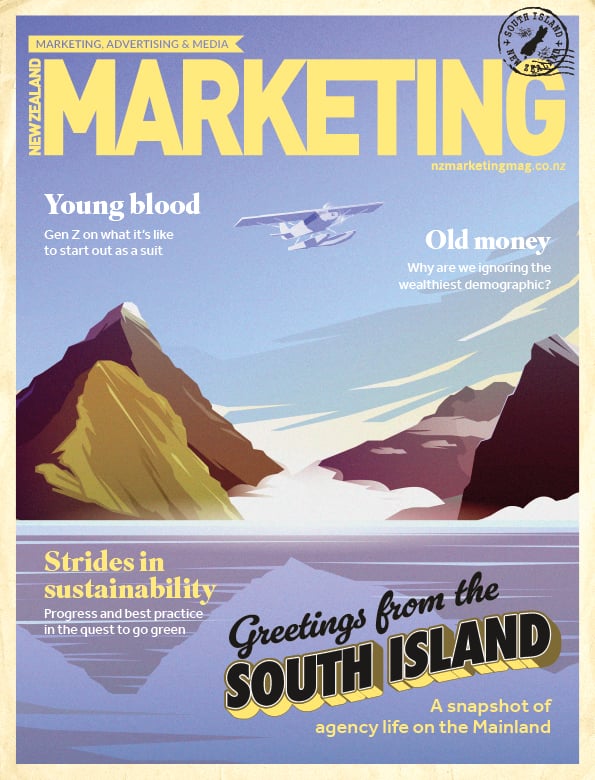
This story comes from NZ Marketing magazine issue 83, Jun-Aug 2025. Why not subscribe? Get four issues a year for just $50 (including delivery) if you autorenew.
Essential marketing intelligence. Don’t miss it.