

A rising credibility crisis sees trust as the new currency, says Thompson Spencer‘s executive account director Molly Scott.
We’re now in an era where trust, not reach, is the most valuable currency a brand can carry.
Depth matters more than scale, and a modest volume of DMs, saves and shares from a post can outperform a million passive impressions.
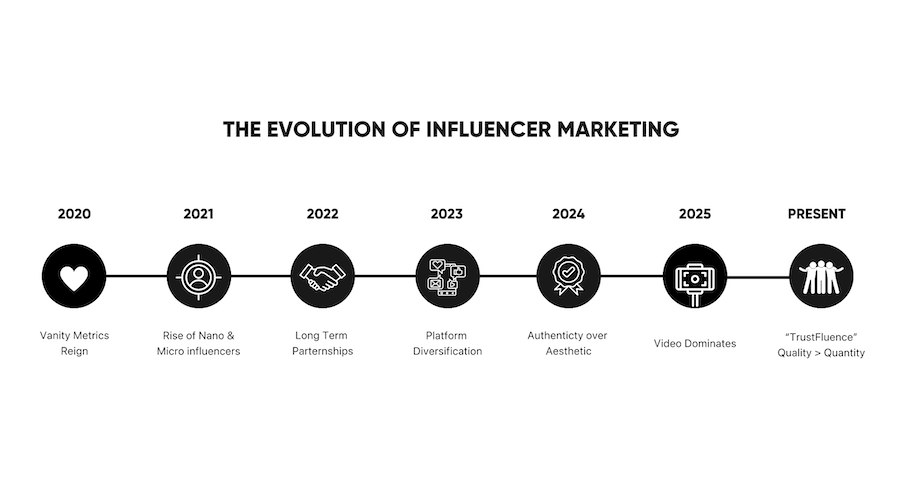
Welcome to the age of trustfluence.
Not for one second are we rejecting AI and technology (we do a lot in that space!). This is about an evolution where humans and machines are in partnership. As algorithms, agents and automation take on more of the buying and optimisation work, brands need a stronger human layer than ever before.
Sure, tech can recommend, compare and transact, but people create belief and connection.
Why ‘trust’ has gone main character
As well as being (rightfully!) dubious of scams, audiences are more sceptical, more ad-aware and more immune to polished messaging.
At the same time, they’re spending more time than ever inside social platforms scrolling for entertainment, discovering brands and reading recommendations.
But who do they trust in that environment? Other people.
Sixty-nine percent of consumers now trust creator recommendations over direct brand messaging.
Influence grows from where the audience senses realness, relevance and credibility – not when they’re being shouted at.
And it’s not just people who are looking for real recommendations: when AI agents are researching products and adding to cart on behalf of their human shopper, they’re taking those same trust signals into account, too. (Side note: if you haven’t seen Thompson Spencer’s white paper on Agentic Commerce, let us know and we’ll send it to you! Robots doing the shopping is not to be ignored.)
Moderate imperfection = maximum credibility
The old adage still stands: If it seems too good to be true, it probably is.
A little bit of imperfection signals trustworthiness.
We’ve consistently seen that a 4.3 – 4.5 star rating is more trusted than a perfect 5. This is because actual, lived experiences are nuanced, so they come with context, trade-offs and honesty. Flawless feeds, scripted testimonials and overly-polished partnerships are now a red flag. In 2026, looking too perfect is a liability.
Creators who share genuine opinions, personal use stories and even mild critiques feel more believable overall. Authentic partnerships with these creators see that trust transfer to brands.
Who you choose to hitch your brand’s wagon to now matters more than ever.
Depth matters, and it’s a human flex
As a metric, reach isn’t going anywhere, and eyeballs still matter… but that’s only part of the story.
The real success of influence now lives in high-intent, personal signals that show resonance and connection are flourishing:
- Saves
- Shares
- Replies
- DMs
- Comments that turn into conversations
A private share from a friend or acquaintance carries weight. So partnering with people who create ‘DM ready’ content – the kind of content people feel compelled to share in their inner circles – should be high on the agenda.
Social is the new search
We’re not Googling like we used to. Late last year, we shared our thoughts on how comment sections are the new town squares. TikTok has become the new Google, and TikTok comments now function like Google Reviews – it’s where many brands now live and die.
People (especially younger audiences) are scrolling for answers, recommendations, social proof and real experiences.
- 46% of Gen Z and Millennials now prefer social media over traditional search engines for information
- 85% of Gen Z engage more with authentic, unpolished content than corporate creative
- Over 80% of Kiwis 18-44 are active on social, with more than HALF purchasing based on an influencer recommendation.
Influencers and content creators reach people when they’re open, curious and browsing – it’s about context, not keywords. It’s a different part of the funnel, and a part not to be ignored: the trust starts building right away while they’re still in the discovery phase.
Bigger isn’t always better
Micro-influencers punch well above their weight.
The future of influence is pointy. Micro-influencers bring special offerings to the table: niche authority. We see this shine in their:
- Tight-knit, engaged communities
- Genuine credibility that can’t be faked
- Highly relevant audiences, rather than broad ones
Shifting their gaze to micro-influencers is also where brands can unlock an often under-used asset: superfans. These are the people who are already talking about you, recommending you, defending you in comment sections and sharing you in the group chat.
The smartest brands go beyond “using influencers” and beeline on over to rewarding advocates and building communities around shared experiences.
From one-and-done to ongoing partnerships
One-off influencer campaigns have their place in driving awareness, but it often takes more than one bite to build ongoing belief and trust.
Credibility grows with consistency over time – think repeated exposure, evolving stories, follow ups and seeing a brand genuinely integrated in an influencer’s day-to-day life.
We’re seeing a move away from transactional campaigns towards ongoing creator partnerships, where influencers are treated as partners, not participants.
Longer-term partnerships can unlock:
- Deeper brand understanding and familiarity
- More natural integration (where the brand doesn’t always have to be centre-stage)
- Higher audience trust
- Better performance over time.
We know that trust compounds, so influence should, too.
So how should we measure influence now?
Vanity metrics are on the out. Influencer marketing has moved from a “nice to have” awareness tactic to a performance channel, and we evaluate it with the same rigour as all paid media.
We focus on:
- Attention – are people watching the full videos? Do they stick around?
- Action – are people saving, sharing, clicking or purchasing?
- Connection – are people replying, commenting and having conversations?
Industry engagement rates sit at about 3-4%. In some of our recent work, we’ve seen creators achieve 8-15% engagement rates, through fostering alignments that prioritise relevance over reach.
The goalposts have moved from views to movement: building trust through discovery, and converting that belief into action.
Trustfluence in an agentic world
The robots need to trust you, too.
As AI agents increasingly search, compare and purchase for their humans, trust signals will weigh even heavier. Machines will optimise, and algorithms will recommend, but ultimately, humans will still decide what feels right.
Influencers and the communities they nurture are the bridge between automated systems and human belief. Humans provide context, credibility and social/cultural cues that technology alone can’t replicate.
In a tech-heavy future, trust is the ultimate differentiator.
Your goodie bag to take home
Influencer marketing is well on its way to a more grown-up glow up.
The brands that will win in 2026 aren’t chasing vanity metrics or one-off hypes that give a nice little spike on a graph. They’re investing in trust, community-building and longer-term creator relationships that feel real, imperfect and resoundingly human.
Belief is the advantage brands can’t automate, and ‘trustfluence’ is key to earning it.