

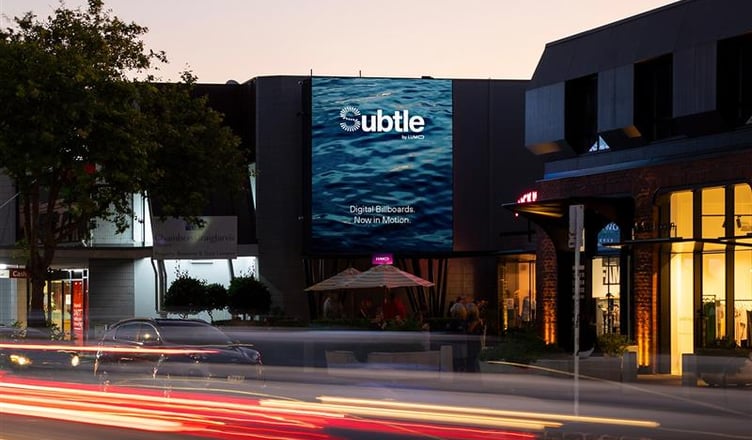
Digital outdoor company Lumo has launched a new way to advertise on big screens: Subtle by Lumo. A first for New Zealand, it allows brands to incorporate gentle movement into digital creative – combining the possibilities of programmatic with animation.
As Subtle by Lumo was unveiled, co-founder and CEO Phil Clemas sat down with NZ Marketing editor Penny Murray to talk about this exciting new platform.
NZ Marketing: Tell us about Subtle by Lumo, it sounds beautiful.
Phil Clemas: That’s a nice way of putting it. We refer to it as the art of gentle motion, and it’s been a long time in the making.
Lumo has been thinking about how we can use motion – so creative is more attractive on our screens. As with everybody who has digital billboards, we’re limited by the council or regulatory restrictions on movement. So everything’s static. There’s lots you can do – particularly with dynamic content optimisation, DCO – and having some movement on a screen has always been one of our aspirations.
About two years ago, we formally made an application to Auckland Council for resource consents on six of our screens. And it took a long time and a lot of work with council to get it across the line. But we finally got approval for Subtle by Lumo.
We’ve dabbled with the idea of allowing advertisers to create content that has a bit of movement in it, and now we can do it with permission. It’s exciting and we can’t wait to get it to market.

What does ‘subtle movement’ mean?
NZM: And so what sort of movement will people be able to have?
PC: Subtle movement…
NZM: The clue’s in the name! [laughs]
PC: Yes! Essentially the bulk of the image will still be static, so not moving. But there’ll be elements within the area of the screen, within the content of the ad that can move.
One of the challenges we had was exactly this. What is “subtle”? It’s hard to pin down. During the process with council, it was hard for us to provide an objective description. And that’s because there are different interpretations of what gentle motion or subtle animation is.
We needed to find an objective measure of the movement. So we went around the world, checking to see if there was any existing software or method to measure movement. There wasn’t.
So we had to create a platform ourselves. Fortunately, we have a great software partner called Latch Digital, who do a lot of our DCO work with us. Their software engineer created this platform that enables us to upload an ad that contains movement.
It measures three key components: the footprint of the movement, the intensity of the movement and the velocity.
There are guidelines for those three and each component provides a score – we can dial up or dial down the parameters. We presented this to council, and they got to the point where they accepted it as a way of measuring speed objectively. Everybody’s happy.
So we have the agreed settings for each component, upload the content to the platform and it’ll either pass or fail. If it’s passed: easy. We can then get that verified and uploaded.
If it fails, the checking platform suggests how it can be amended to then get to the level where it passes. It’s very clear.
NZM: So each adverts has to sit a test before it’s allowed to go live?
PC: That’s right. As part of the condition of consent, it needs to pass through the software platform and get independent verification from a traffic expert. So it’s a bit of a process, but it only takes a few hours. It’s not a big deal if everybody’s organised.
The council is quite strict, but that’s fine, because the process allows us to get subtle animation up on our screens. It’s a very exciting step forward, not only for us obviously, but also for the industry.
There will be others who will apply for consents, I’m sure, in due course. And we’ll be able to see subtle animation right across the networks in New Zealand in the future. That’d be great.
Safety first
NZM: Super exciting. All of this checking and making sure the creative doesn’t move too fast or isn’t too intense, it comes down to driver safety, doesn’t it?
PC: Yeah, yeah. Digital billboards have been in the market since 2013 in New Zealand. That means we’ve got many, many years of experience and evidence to prove that digital billboards – as they are now – have no negative effect on road safety. That’s a fact.
Our view is that having subtle animation, a little bit of movement, doesn’t change that safety outcome. But of course, traffic engineers within Auckland Transport have a different view.
So we had to help overcome their concerns about the potential for road distraction – hence the process we went through, and hence the development of that software measurement platform.
There are many examples around the world of roads with busy traffic, with full animation playing, and there is no evidence in those markets that the full animation has any negative or detrimental effect on road safety.
It’s a very risk averse view in New Zealand, and I get that.
A world first (we think)
NZM: As you say, there are examples of full animation out the in the world, but is there anywhere else with a very conservative approach to safety that has managed to do this sort of subtle movement?
PC: I’m not aware of any. Most screens that have full animation are the ones that we are all aware of – Times Square or Piccadilly Lights in London, and Vegas has animated screens all down the strip.
There are many examples, but the vast majority of digital billboards around the world are static. It’s all about road safety, as you quite rightly pointed out before. There are many screens in pedestrian areas – shopping malls, airports – that have movement. But I’m not aware of any roadside large format digital screens that have subtle animation.
Time to get creative
NZM: The Pixel Awards are coming up. Are you hoping to see subtle movement taking digital and programmatic creativity to the next level?
PC: Absolutely. I’m very excited. I’m expecting creative agencies will jump all over it. Designers will jump all over it, and brands will get to understand what that they can do with their advertising campaigns, even down to programmatic training platforms.
We’re excited that’s going to open up this new format for advertisers to use on these great big TV screens we have all over the cities. It’s going to be great.
NZM: When will we see the first Subtle movement ads out there?
PC: The week of March 30 is when we’ll see the first Subtle brand ads appearing on any one or all of the six screens that we have permission to for.
But first, we’re going to run some ads on these screens promoting Subtle by Lumo. That’ll be quite cool.
Auckland is just the start
NZM: Fabulous. You’ve mentioned screens in Auckland, is it in other cities as well?
PC: Strictly limited to the six screens that we applied for in Auckland. But we are actually now in the process of where do we go next? And for us it’ll be Wellington and Christchurch and then have across a whole network in time. So that’s our plan.
NZM: Lovely. Was there anything else that you wanted to add?
PC: I think it’s nice that this is happening the year where we celebrate our 10th anniversary as a business. Back in 2016, Kent [Harrison] and I stepped away from a big corporate and thought it might be a nice little idea. Lumo turned out to be something a little bit bigger than we thought.
And then the expansion of the Pixel Awards later this year will be another way to celebrate Lumo being around for its first decade.
NZM: What a great way to celebrate turning 10. Congratulations.