

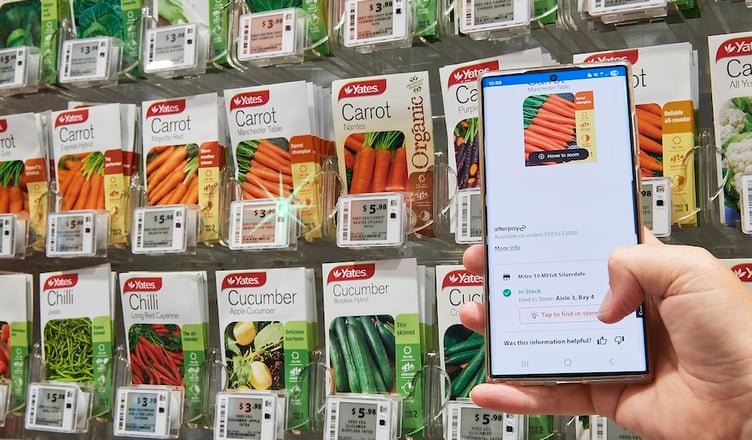
Kiwi hardware retailer Mitre 10 has deployed digital tools to solve an age-old retail problem: lost customers wandering in circles around stores trying to find a product.
It’s a scenario many DIY enthusiasts know too well: after meticulously researching which drill bit to buy, you head to the hardware store, only to be faced with a wall of bits that look the same.
Mitre 10 has made finding the right item much easier with its new feature: ‘Tap to Flash’. It’s a first for New Zealand retail, allowing customers to make a product’s shelf label flash as they shop in-store, using their phone.
The innovative tool has been introduced at 20 Mitre 10 stores (the ones with electronic shelf labels) and has been getting rave reviews, according to Natalie White, lead product manager at Mitre 10.
“Team members say they had literal squeals of delight from customers when they saw the light flashing.”
Tap to Flash is an extension of Mitre 10’s digital wayfinding tool, developed with customer experience platform Mastercard Dynamic Yield. Mitre 10 shoppers have used the wayfinder to navigate to the correct aisle more than 5 million times.
The tool saw Mitre 10 awarded an Honors for Innovation in the global Mastercard Circle of Honor in 2025. Mitre 10 head of digital customer experience Lewis Billinghurst says it was a huge moment to be named alongside some of the world’s best-known brands for the award.
“It’s not often a little retailer at the bottom of the world gets their logo next to the likes of Hewlett Packard or Lowe’s Home Improvement, so that was a cool thing for our team to see,” he says.
“There’s an entrepreneurial spirit in Mitre 10 with our store owners. They do amazing things at their local stores, which is great to see reflected against these giants who we can’t compete with from a resourcing perspective. New Zealand’s innovative spirit is still alive.”
Although they use a variety of data and analytical tools to help identify customer needs, White says there’s still a place for the old-school approach of observing how customers behave in-store.
“If you just sit on the outdoor furniture and watch what the customers do, they come in holding their phone, looking around. Or they go up to Gary in the power tools department and go, ‘Where’s this?’
“You can see that there’s a need there. They’re already using their device, so how can we help them?”


Evolving approach
Billinghurst says there has been a rapid evolution in how retailers connect the physical and digital space in the past couple of years. It started on the back of the Covid lockdowns.
“Covid literally forced the physical doors shut for all retailers, so New Zealanders jumped online. For a lot of customers it was the first time they’ve online shopped,” he says.
“As soon as those physical doors opened again, they stopped online shopping as much, but they’re still using digital channels to research.”
Billinghurst cites NZ Post research that found 64% of New Zealanders browse online before they go into a physical store, including checking the price and availability of products.
“That’s very much attuned to our business. We have 87 stores and we’ve got strength and breadth across the country, so there’s typically a store 10 minutes’ drive from your house. The website plays a big role in those in-store sales.”
New metrics reflect changing shopping habits, Billinghurst says.
“Any online retailer will have sales metrics and conversion rates and online shopping metrics. Now we also have metrics around how many of our customers are browsing and researching and looking on the website, and where that purchasing is in store.
“We have a metric we call digital influence, which is saying we know through data that the website played a part in that customer journey.”
White says Mitre 10’s in-store experience innovations show it’s truly becoming ‘omnichannel’ in how it interacts with customers.
“Now we’re asking: how do we help the customer journey work across whatever channel they’re wanting to use to do their way of shopping?
“In a hyperpersonalised world, customers choose their shopping journey. We need to support it and get out of their way, making it easier for them.”
This story comes from NZ Marketing magazine issue 86, March-May 2026. Why not subscribe? Get four issues a year for just $50 (including delivery) if you autorenew.
Essential marketing intelligence. Don’t miss it.