
Every month the Together team highlights five media stories from Aotearoa and globally that defined the month, and one great media idea we love. January kicked off with a clear theme: the interfaces where people discover brands are shifting fast, and measurement, creativity and “agentic” tools are scrambling to keep up.
Prediction season: views from NZ and around the world
It’s the start of the year, which means it’s prediction season. Here are three of the best to check back on in December:
Locally
- The Spinoff: A sharp list of the big questions, including sustainability of business models and what platform power means for local media.
- NZ Herald (premium): A broad “26 predictions” sweep (paywalled, but useful as a temperature check on consolidation chatter and the year’s potential flashpoints).
Globally
- Reuters Institute: Reflecting a survey of 280 digital leaders from 51 countries and territories. News leaders are bracing for the squeeze between generative AI distribution and the rising power of creators, with trust and business model reinvention front and centre.
ChatGPT gets ads (and a new kind of ‘search moment’)
OpenAI has confirmed it will begin testing ads in the US across the Free and Go tiers, with ads clearly labelled and kept separate from answers. Early formats are positioned as relevant sponsored products or services placed at the bottom of responses, with personalisation controls and commitments not to sell conversation data to advertisers.
What this means for NZ marketers:
- The disruption is intent without keywords. If the ad unit is triggered by conversational context, then your future “search strategy” becomes part SEO, part PR, part product truth. The brands that win will be the ones that are easiest for LLMs to understand and confidently recommend.
- Creative and offer clarity will matter more than click hacks. If the ad is adjacent to an answer (not a feed), anything that feels like classic performance spam will look especially out of place.
- Start planning for AEO/GEO seriously. Structure your product and brand signals so models can parse them: clean product feeds, clear availability, strong reviews and consistent brand cues across the open web. Some early commentary suggests this won’t behave like Google or social targeting, which is exactly why it matters.
Deeper reads:
openai.com/index/our-approach-to-advertising-and-expanding-access/
discoveredlabs.com/blog/chatgpt-ads-vs-google-gemini-ads-which-platform-should-you-prioritize
The Creative Dividend lands: a confidence playbook for investing in creativity
Effie and research firm System1 have launched The Creative Dividend, linking creative quality and media support to real business outcomes at unusual scale. The report argues that creative and media decisions are inseparable if you want reliable, repeatable growth.
A few sharp takeaways for marketers (from the report itself):
- Across 1,265 campaigns, creative quality and media support explain 60% of reported business results.
- The framework pushes you to measure creative advantage relative to competitors, then back it with enough weight for effects to land, not just appear in dashboards.
- It’s also blunt about the trap: low confidence drives short-term metric chasing, which makes long-term effectiveness harder.
What this means for NZ marketers:
- This is ammo for braver briefs. The most useful role of the report is internal: helping marketing leaders defend investment behind ideas that actually earn attention and then staying consistent long enough for compounding returns.
- It nudges NZ back towards scale. In a small market, we often confuse “efficiency” with “effectiveness”. This report is a reminder that reach and consistency are still the unlock, if the creative is strong enough.
Download the report here:
system1group.com/the-creative-dividend
Clawdbot becomes Moltbot: the hype is a signal, not the point
The viral personal assistant originally known as Clawdbot has rebranded to Moltbot, following a trademark-related request linked to Anthropic’s Claude ecosystem. But the name change is almost irrelevant compared to the speed at which the tool has spread.
In the space of a few weeks, Clawdbot/Moltbot went from a niche GitHub experiment to one of the most talked-about “agentic” tools online. The project quickly racked up tens of thousands of stars and forks on GitHub, spawned hundreds of community-built plug-ins, and drove a surge of explainer videos and demos across X, Reddit and YouTube. Several tracking sites put it among the fastest-growing open-source AI agents to date, with daily active users reportedly jumping multiple times week-on-week at its peak.
What’s driving the explosion is not raw model performance, but form. Moltbot lives inside tools people already use (Slack, email, browsers, task managers) and can chain actions together: reading messages, booking meetings, researching options, drafting responses and executing follow-ups without constant prompting. For many users, this is the first time an “AI agent” has felt genuinely useful rather than theoretical.
Why marketers should care
- This is the agent UX people actually want. Not another chatbot tab, but an assistant embedded in everyday workflows, capable of handling tasks end-to-end.
- Agentic brand risk is real and accelerating. As consumers start delegating decisions to agents like this, brands will increasingly be judged on what an agent can verify quickly: price, delivery speed, availability, returns, reviews, trust signals and clear FAQs. If your brand data is incomplete or contradictory, an agent may quietly route around you.
- The next battleground is partnerships and permissions. Moltbot-style tools sit on top of APIs, inboxes, calendars and commerce systems. Brands that make it easy and safe for agents to access product data, check stock, generate quotes or complete transactions will be disproportionately discoverable in an agent-mediated world.
- Open-source means fast iteration and low control. The same community energy that fuels innovation also creates unpredictability. For marketers, that raises new questions about brand safety, data access and how recommendations are formed when tools evolve in public.
The rebrand to Moltbot may cool the headline hype, but it’s obvious agentic behaviour is moving from concept to habit. 2026 is the year marketers need to think less about “how people search” and more about “how agents decide”.
Google vs BARB on YouTube measurement, as NZ lines up its own review
In the UK, Google has issued cease-and-desist action against BARB/Kantar Media over YouTube measurement that compared YouTube viewing with broadcasters and streamers, reigniting the platform transparency debate.
Meanwhile, TVNZ and Sky are preparing a process to review the NZ TV measurement solution, via a formal tender process. With the Nielsen contract up for review in mid-2027, these two broadcasters are taking the opportunity to assess what a future-fit audience measurement solution should look like for New Zealand.
What this means for NZ marketers
- Measurement is now a strategic negotiation, not a neutral utility. As what we define as “TV” is re-invented and reimagined (and argued over), measurement is a critical battleground in the pursuit of ad dollars.
- Expect more friction around “what counts”. Cross-platform video planning is only as good as the comparability of the data. NZ’s review process is timely, and marketers should push hard for transparency, durability and consistent definitions.
Media idea we love: Stella Artois turns snowfall into a contextual stunt
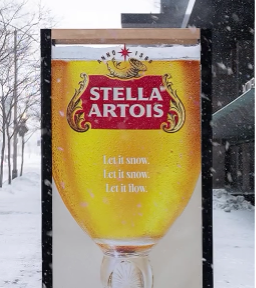

In January, Stella Artois tapped into record snowfall in Canada. Its smart, context-led activation effectively made weather the media channel. They turned record snowfall into a piece of “only-here, only-now” brand theatre. A giant chalice installation filled with snow to mimic foam, making the weather the creative. It’s a neat reminder that in an age of infinite targeting, situational relevance still hits hardest when it’s simple, timely and designed to be talked about.
Why we love it
- Context is everything. Reactive, but not random: the environment is the message.
- It earns attention. No targeting hack, just a smart, conspicuous idea that people want to talk about.
- It’s brand-correct. The chalice is distinctive, premium and instantly Stella.