


Marketing doesn’t always get the respect it deserves. It should be the engine room of any business, but are we fulfilling that promise? Get ready to consider what’s compelling and what’s colouring-in.
Perhaps marketers make it look too easy. Because don’t all good ideas seem obvious once you hit upon them? Never mind the hours and days brainstorming, the Post-its layered so thick you can’t see the walls, notebooks full of scrawls. It’s complex to make something look simple, but few people see the sweat along the way.
Perhaps we don’t sell ourselves very well. Too busy listening to customers, seeing round corners, predicting demand. Businesses think it’s good when the marketing department is humming, but are you producing results or just activity for the sake of it?
If your work isn’t shifting the needle, it could be time for a different approach. Think about how you demonstrate your value to the C-suite. How do you present your vision of ways the brand can thrive and – perhaps more importantly – how marketing can help get everyone there?
Perhaps we’re measuring the wrong things. Do clicks matter if people aren’t buying? Does a viral video shift units? Are the punters just scrolling past? You might as well be promoting your competition if you show up in the same way. Where’s the creativity – stifled because ‘safe’ is all you can get signed off?
Perhaps we’re talking past our audience. Do we really understand what it’s like to be them? You don’t have to be young (or brown or diferently abled or a parent…) to ‘get it’, but what a huge advantage to have someone with that background helping drive the vision. Your customers aren’t just one type of person – you need diversity on your team, too.
Perhaps we’re presenting logic when we should be seeking love. Too much performance marketing when most of your customers won’t buy this quarter or even this year. They don’t care about the 14 functions of your fridge, they want to feel cool when your brand is in their kitchen.
Does marketing need a rebrand? Read more from the colouring-in issue here






The colouring-in department
With all of these caveats, is it any wonder some businesses doubt marketing’s power to contribute to business goals and drive growth? Is it any wonder it gets called “the colouring-in department”?
“I don’t think people do call it the colouring-in department,” says John Miles, CEO of the Marketing Association.
He pauses for a moment. “In my experience, that line normally comes from people with fairly limited commercial nous.”
Comms Council CEO Simon Lendrum agrees: “Mature businesses don’t treat marketing as decoration, they treat it as a central function that needs to compete for finite resources alongside other business units.”
So why is it often the first budget that’s cut when money is tight? The problem stems in part from where it appears on the balance sheet, says Lendrum.
“The challenge is that marketing is overwhelmingly classified as opex. It falls into the accounting bucket of variable costs and is therefore more susceptible to cuts when times are tough.”
CMOs take the reins
Of course, nobody needs to convince heads of industry bodies of how marketing can supercharge business. When marketing has an advocate at the top table, great things happen. Miles points to the growing number of CMOs who have gone on to lead major companies in Aotearoa. He reels off a bunch of names: Vittoria Shortt at ASB, Wendy Rayner at Coke, Clive Ormerod at AS Colour, Jason Paris at One NZ.
“Why was Frankie Coulter headhunted for The Warehouse?” he asks. The Goodman Fielder CMO was named Marketer of the Year at the YouTube NZ Marketing Awards 2024, and GF’s Vogel’s picked up Brand of the Year in 2025 – growing unit sales even after increasing the price of a loaf. Just the kind of approach needed to help revive the big red shed.
“Brands that want to grow value marketers because marketers are wired for growth,” Miles says.


Lost in translation
Clearly, many businesses get it – why not everyone?
Problems arise when marketers and C-suite don’t speak the same language, says Lendrum.
“Where marketing is not taken seriously, that suggests a disconnect between the CMO and the CFO,” he says. “We can blame the CFO for not understanding marketing, or we can help the CMO embrace the language of finance to prove the case for marketing.
“The disconnect occurs most readily when we fail to translate and align what is important to marketing to outcomes that are important to the business.”
To be more effective, marketers need to overcome the language barrier, says Lendrum.
“Marketers have a huge weight on their shoulders. They need to instil confidence in the C-suite and justify ongoing investment. They need to make increasingly difficult calls about the horses to back and those that don’t justify support. And they need to prove the importance of balancing future demand with maximising returns on current demand. All of which needs to be translated into the language of finance and outcomes that excite the CFO, shareholders and the CEO.
“To be effective in this context is to be multi-lingual,” Lendrum says. “Hold on to the core strength that great marketers have always held, and to apply it both externally and internally: know your audience and speak their language.”
Tell a better story
Industry veteran Mike Hutcheson puts it this way: “Marketers need to tell better stories.” Hutch knows a thing or two about telling stories – creativity and innovation are specialist subjects for the serial founder (Colenso and HKM among them) and former MD at Saatchi & Saatchi.
He’s not alone in worrying that many marketers now concentrate on generating easy-to-measure metrics like reach and impressions at the expense of work that has real emotional depth.
Whether you’re selling products to customers or selling the brand vision to the C-suite, everyone connects to stories, he says.
“I’ve been saying it for years: agencies should stop being advertising agencies and marketing departments and become ideas factories for commerce. So these people should be not just doing ‘colouring-in’, but thinking about ideas.”
Where do ideas come from? Nothing beats a broad education and a wide variety of interests, says Hutch. Your experience and background are ingredients that allow you to put thoughts together in new ways. The more you have, the more things you can dream up.
“You can only make a cake out of stuff that’s in your pantry,” he says. “So what’s in your pantry?”

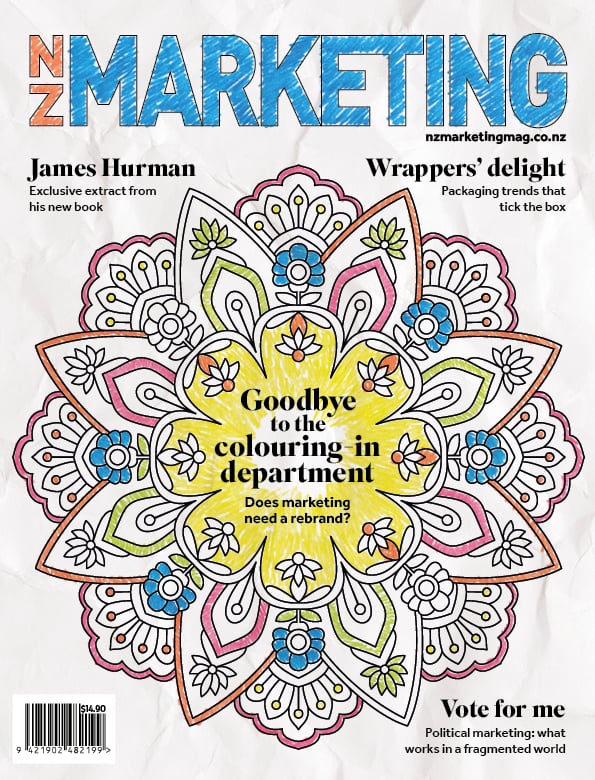
This story comes from NZ Marketing magazine issue 86, March-May 2026. Why not subscribe? Get four issues a year for just $50 (including delivery) if you autorenew.
Essential marketing intelligence. Don’t miss it.