
Every month the Together team highlights five media stories that matter for marketers, and one media idea we love. In May, we unpack the latest shifts in AI-powered marketing, streaming and retail media.
Google Marketing Live 2026: AI becomes the operating system for ads
Google Marketing Live 2026 was less a product update and more a statement of intent: Google wants AI embedded across the full marketing workflow, from planning and creative to measurement and commerce.
The biggest announcements centred on Gemini-powered ad experiences in AI Search, AI Max, Asset Studio, new YouTube Demand Gen tools and Ask Advisor, a cross-product agent spanning Google Ads, Google Analytics, Merchant Center and Google Marketing Platform. Google also pushed further into agentic commerce, expanding its Universal Commerce Protocol and Universal Cart. This means products can be discovered, compared and bought across conversational AI surfaces.
For NZ marketers, many of the developments aren’t here yet. But they demonstrate how central AI is to Google’s future plans. They reinforce some practical points. Search is becoming less about keywords and more about being interpretable to AI systems. Product feeds, pricing, stock levels, creative assets, FAQs, reviews and brand claims all need to be structured, current and machine-readable.
But the other watch-out is control. As Google automates more of the campaign workflow, marketers will need to be sharper on inputs: business goals, margin data, audience exclusions, creative guardrails and measurement design. Our view is the brands that win in this next phase will not be the ones that simply “turn on AI”, but those that give the machines better data, clearer commercial rules and smarter strategic oversight.
Read more here: blog.google/products/ads-commerce/google-marketing-live-2026-collection/
Sky and Neon rebuild the slate before HBO Max arrives
Sky’s rebranded Neon this month and announced a range of new content. This is best read as a defensive and strategic reset, not just a programming update. With HBO Max launching direct-to-consumer in New Zealand imminently, Sky has confirmed it will not be keeping its WBD content previously housed on Neon. That means premium HBO and Max titles leave Neon and Sky just as Warner Bros Discovery starts building its own local subscriber base.
In that context, Sky’s new entertainment slate is an attempt to show viewers and advertisers that Neon still has depth beyond HBO. The new line-up includes Fifth Season dramas such as The Good Daughter, The Blame and The Westies, a new Sky Originals crime drama Bust Up and anime from Crunchyroll including Jujutsu Kaisen, Spy x Family and Cowboy Bebop.
For NZ marketers, this marks another step in the fragmentation of premium video. The old model, where Sky and Neon offered a relatively consolidated premium entertainment environment, is breaking apart. HBO Max will add another direct streaming destination, while Sky is rebuilding around a more diversified mix of studio deals, local originals, genre programming and youth-skewing fandom content.
The planning implication is that “premium video” needs to be treated less as one buy and more as a portfolio. Neon may lose some global prestige halo when HBO exits, but it still has local scale, sport-adjacent brand strength and a growing entertainment proposition. HBO Max, meanwhile, will likely arrive with powerful appointment-viewing titles and global IP, but its ad model, local scale and commercial access remain the key questions.
For brands, the smart move is to plan for audience behaviour rather than platform loyalty. Expect heavier subscription juggling and rationalisation, more content-led churn and sharper differences between environments. The battle for our sofas is heating up again!
ChatGPT moves from experiment to performance channel in waiting
OpenAI has switched on cost-per-action buying inside ChatGPT and is rolling out paid ads for New Zealand advertisers. It follows a rapid build-out of OpenAI’s ad stack, including its ads manager, CPC buying, a conversion pixel, catalogue-driven retail ads and broader access for advertisers.
This further shifts ChatGPT ads from interesting test budget into something closer to a performance platform. CPA buying requires conversion tracking, optimisation logic and enough advertiser demand to make the auction work. In other words, OpenAI is building the foundations that made Google and Meta so commercially powerful.
For NZ marketers, CPA buying is a way away yet, but ads are coming to ChatGPT imminently with a CPM model and basic initial targeting. Global tests suggest outstanding conversion rates but with high costs, reflecting the role LLMs play in pre-qualifying audiences. Just as we have always done with SEO and paid search, NZ marketers should be developing robust testing strategies to balance organic discoverability with paid recommendation.
Netflix’s ‘Binge Ads’ format, sequential storytelling built for connected TV
Among the product announcements at Netflix’s 13 May upfront, the streaming giant unveiled Binge Ads. This is a new format that serves sequential creative across episodes in a single viewing session, allowing brands to build narrative arcs rather than just repeat a single 30-second spot. The format is designed specifically to capitalise on Netflix’s data on viewing session length and episode completion rates.
What does this mean for NZ marketers? This is a direct challenge to the “one TVC, run everywhere” briefing model. Sequential CTV storytelling requires brands to think in acts rather than messages, which is both a creative opportunity and a resourcing challenge. While this isn’t slated to be released in New Zealand until 2027, it’s an interesting evolution for Netflix as they continue to evolve their ad funded model. For brands with strong story to tell, the attention environment of a Netflix binge session an exciting new opportunity on the horizon.
Read more here: marketingdive.com/news/netflix-flexes-new-capabilities-as-ad-biz-doubles-geographic-reach/820098/
Cartology digitises point-of-purchase via mass Woolworths network expansion
On May 21, 2026, Cartology New Zealand announced a substantial expansion of its physical in-store digital media footprint across Woolworths Supermarkets nationwide. The rollout activates over 1,500 assisted checkout screens with full-motion video capabilities, alongside 700 weigh-scale screens placed directly in high-dwell deli and seafood zones. This lifts Cartology’s local screen footprint to 2,700 assets.
Retail media has officially burst out of the online web banner and onto the physical grocery floor. For FMCG and household marketers, this allows digital video creatives to be dynamically extended to more than 400,000 unique weekly shoppers at the precise micro-moment of purchase consideration. Bidding strategies can now map directly against physical aisle location and immediate transaction data.
Read more here: cartology.co.nz/news-resources/cartology-in-store-screen-network-expands-across-new-zealand-woo
Media idea we love: Purina turns billboards into birdhouses
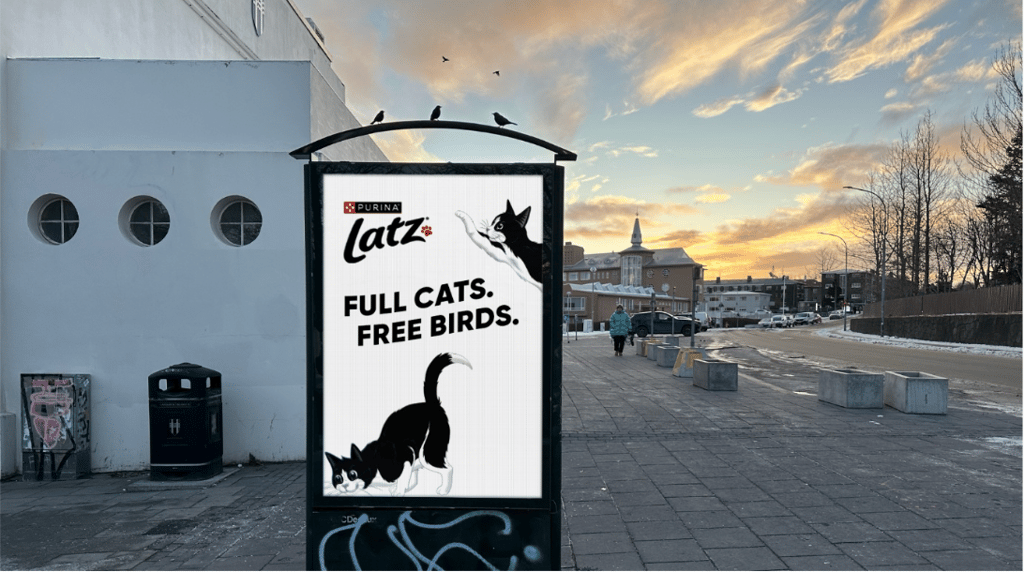
In Reykjavík, Purina Latz did something quietly brilliant with its outdoor media budget. Rather than plastering a standard cat food ad across a billboard, the brand, working with agency CiRKUS, converted its OOH placements into elevated, predator-proof birdhouses. The logic is beautifully simple: a cat that’s full doesn’t hunt. So the billboard does double duty, selling the product and demonstrating its benefit in the most literal, visible way possible.
Why we love it
The medium became the proof point. This isn’t a billboard about cat food. It’s a billboard that shows what cat food does. The environmental intervention collapses the gap between claim and evidence, no copy needed beyond the tagline: Full cats. Free birds.
It earns goodwill, not just awareness. At a time when consumers are increasingly skeptical of brand purpose, this sidesteps the performative entirely. There’s no campaign hashtag asking you to care. The birds just… live there. That restraint is what makes it land.
It’s genuinely talkable. You don’t need a media budget to amplify it, the idea does the work. A birdhouse on a billboard in the middle of a city is conspicuous, charming and slightly surreal. That’s the kind of thing people photograph and share without being asked.
Read more here: adsoftheworld.com/campaigns/full-cats-free-birds