

Storm Day, Accenture Song NZ Lead and CEO of Droga5 Aotearoa, says customer experience isn’t a ‘nice to have’ – it should be at the core of every decision.
In a business environment that’s still sluggish, the secret to driving growth could be down to one simple, age-old trick: keeping your word.
New Zealand is staring down the barrel of a stubborn disconnect between what brands promise and what customers experience. We call this the ‘brand experience gap’, and the latest data shows it remains staggeringly high.
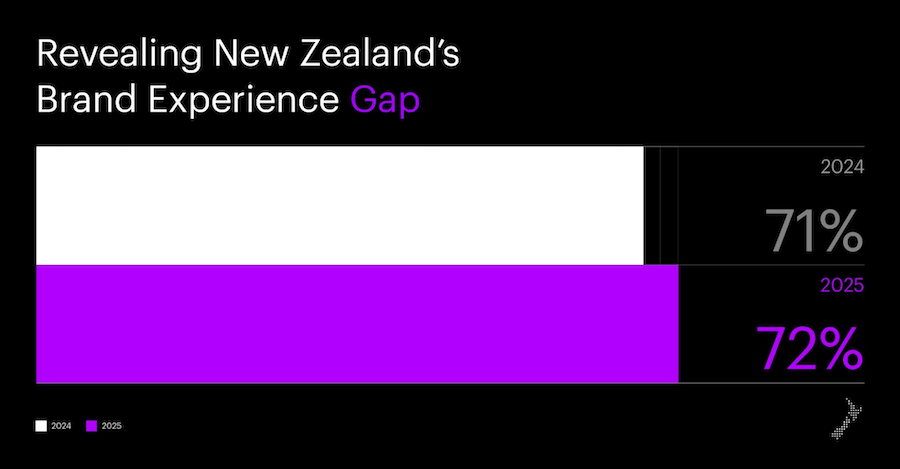
The Accenture Song survey found that three-quarters (72%) of Kiwi consumers saw a significant gap between a brand’s promises and what they actually experienced – an ‘experience gap’ of 72%. This is up from 71% last year.
That might sound like a minor shift. But it signals a deeper issue: the experience gaps aren’t being fixed. And customers are noticing.
What customer experience really means
Customer experience doesn’t start and end with a call centre or website. It’s the sum total of every interaction a person has with your business, from advertising to checkout, to service and follow-up. It’s how they feel about your brand.
When this experience doesn’t match the brand message – when you say “easy, fast, reliable” but deliver “confusing, slow, frustrating” – that’s when the gap forms.
And with consumer confidence still on the pessimistic side, wallets are tighter and people are more conscious of whether brands are living up to expectations. That comes with its challenges, of course, but also its opportunities.
What does this mean for Kiwi businesses?
This isn’t just a marketing problem; it’s a leadership issue. In a tight economy with rising costs and other pressures, many businesses are trying to manage the best they can. But while focus shifts to short-term profitability, customer expectations continue to rise.
The biggest overall gap was customers not feeling valued and recognised by the businesses they deal with (an experience gap of 79%). If your business can’t show them you care, they’ll quietly walk.
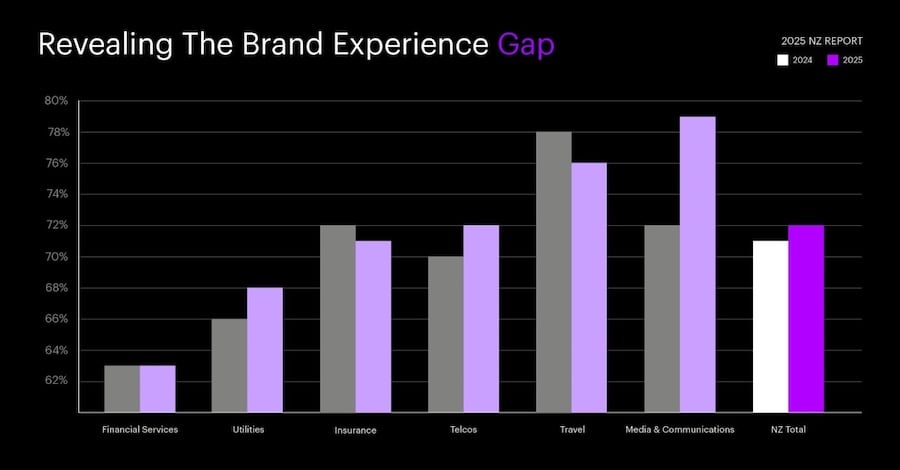
Some businesses are navigating this well. Looking at individual sectors, financial services brands lead the way, with the smallest gap at 63%. This is because banks have made visible moves to address consumer concerns, particularly around scams and security, with recent initiatives such as the new Anti-Scam Alliance.
One opportunity on the horizon is open banking. As Aotearoa progresses toward more open financial data, this could provide a platform for banks to further build trust and create tailored experiences.
What the Aussies can teach us
While our gap has widened, Australia’s is shrinking, from 71% in 2023 to 68% in 2025. Like us, their financial sector has improved the most, with its gap down to 62%.
Australian brands are treating customer experience as central to their business, not just a support function. They’ve invested in capability, culture, and technology like AI that supports customer experience, not just productivity.
New Zealand has the same potential. We just need to shift our mindset: customer experience isn’t a ‘nice to have’, it should be at the core of every decision.
Don’t just mind the gap – close it
You don’t need to be a major bank or global brand to close your experience gap. What you do need is focus.
Start here:
- A meaningful purpose at the heart of the organisation that unites culture, operations and customer experience
- Clarity on who owns customer experience across the business, not just in marketing
- Real investment in training, systems and service, not just in shiny campaigns
- Honest measurement. Ask your customers where the gap is and act on it
A good starting point? Walk in your customer’s shoes. Try your online checkout, call your service line, experience your onboarding process. Would you come back?
Another way to elevate brand experience is through AI, which can help provide a personalised experience for customers. Using data to uncover individual customer needs and responding to them promptly can lead to a better brand-customer connection.
Recent data from Accenture supports this: Companies applying generative AI to customer-facing initiatives are expected to achieve up to 25% higher revenue over five years, compared to those focusing solely on using AI for productivity.
The quiet cost of inaction
Here’s the hard truth: most customers won’t complain. They’ll just disappear. In a small but mighty country like ours, word travels fast.
The cost of a poor experience isn’t always loud. But when trust erodes, it can take years to rebuild.
A time for bold, customer-centred leadership
New Zealand businesses are resilient, creative and full of heart. But the gap between what we say and what we do is growing.
Now’s the time to act with empathy and urgency. Because customers’ expectations will continue to rise. And they’re not just listening to your ads, they’re watching what you deliver.
The Brand Experience Gap research was conducted by Accenture Song and Fiftyfive5 across New Zealand and Australia.