
How-to advice for including disabled people in advertising.
When Special began creating the Inclusive Code, they never thought it would take two years.
But, says Special’s chief strategy officer Rory Gallery: “If you want to truly understand audiences, you have to stop and make time.”
Breaking barriers
It all started when Special decided it wanted to help advertising be more inclusive for communities typically under-represented and underserved, says head of strategy Bethany Omeri.
It’s a multi-part project and chapter one, launched in October, focuses on the disabled community, who make up 25% of people in Aotearoa. Special created the code in partnership with specialist consulting agency All is for All and Mana Pasifika Disabled Peoples Organisation.
“Disabled people with lived experience should lead the creation of the solution,” says Omeri.
CEO of All is for All Grace Stratton acknowledges change can be hard, especially when you don’t have guidance from someone with lived experience, and you’re scared of getting it wrong.
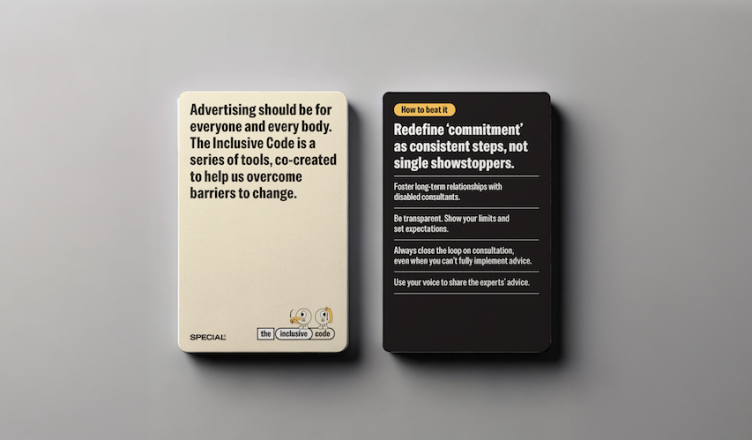
But this is the hurdle the Inclusive Code hopes to clear, she adds. It’s a tool agencies and their partners can consult to kick start what accessibility will look like in their work, says Stratton.
Wins all round
“If we can create work that all people can engage with or enter without barriers, our work will also perform better.
“It’s not just a nice to do, it is an imperative in terms of advertising performance.”
Disability is an uncomfortable topic for many, because there’s an inherent belief that being disabled is bad, says Omeri. But accommodating disability can lead to better ways of doing things for everybody, she says.
“The telephone is probably the best example of something that was actually invented for someone who is hard of hearing that has actually ended up becoming the most important piece of technology that people can’t leave home without every day.”
Build inclusivity in
Gallery says Special wants to ensure it “walks the talk”, so the agency’s next steps involve sitting down, client by client, to discuss how they can best use the code to achieve inclusivity in their work.
“I don’t want to fall into the same challenges – we get a brief and by the time we start talking about it, there’s two weeks to turn it around. Whereas if we build inclusivity into the general conversation around strategy, brand planning, what the organisation’s trying to do, that means we will make time for it.”
The agency has already started updating its brand identity as a result of the project, he adds.
“There was great satisfaction actually, seeing that it wasn’t just theoretical but something we were living and breathing.”
For Omeri, she loves seeing how the code has sparked lots of creativity internally at Special and more personally, how rewarding it has been to step out of the comfort zone, make a few mistakes along the way and then learn as a result.
“It was definitely uncomfortable to facilitate some of the sessions. I wasn’t always sure what to say or what to do… but I think it’s totally fine to get things wrong so long as you just keep moving.”