

Kaitlin Mitchell, Business Director at MBM, discusses how out of home media is evolving into a dynamic, data-driven canvas.
For decades, out of home has been marketing’s ultimate broadcast medium – big, bold and impossible to ignore. But as digital transformation reshapes every aspect of media, OOH is quietly undergoing a significant evolution in the marketing industry. What was once static and one-way has become fluid and interactive – responsive, data-driven and contextually alive.

Across our industry, the format is being reimagined not as an awareness channel but as a dynamic, interactive canvas. Programmatic capability, real-time data integration and location intelligence have given OOH new power, blending creativity with precision in ways that rival digital. The boundaries between storytelling, technology and place are dissolving, giving brands the ability to communicate in real time, in the real world.
Its new power lies in its ability to respond. Today’s screens can pull live data, adapt messages by suburb and reflect what’s happening in people’s immediate environment. That shift from static awareness to situational relevance is rewriting the rules of outdoor creativity.
Beyond billboard boundaries
It’s more important than ever that we move beyond yesterday’s boundaries in our creative and strategic thinking for 2026. Agencies should be looking to hero out of home with emerging technology and functionality, something our teams have embraced in recent campaigns with Fire and Emergency New Zealand (FENZ) and Dulux.
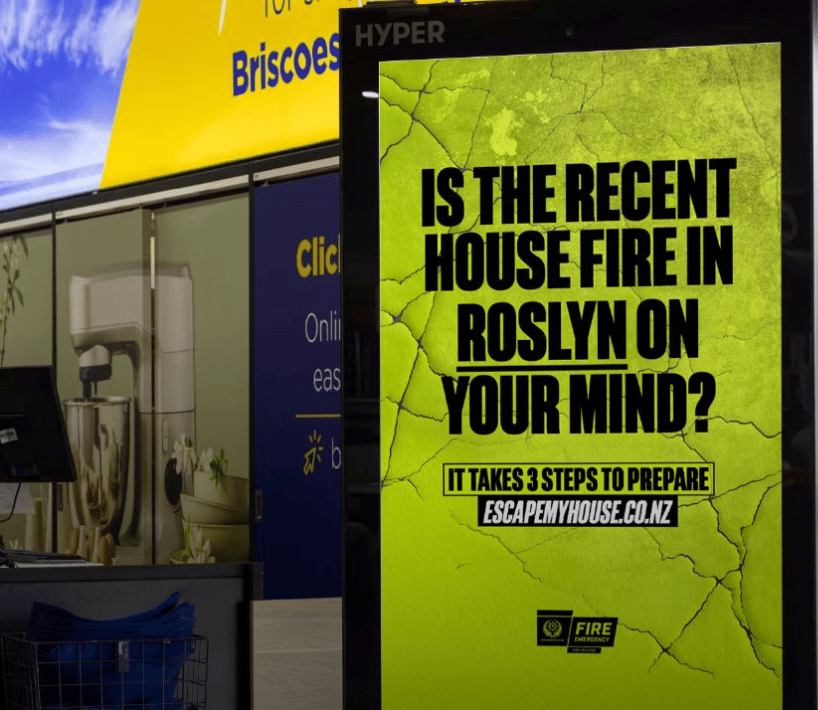
For FENZ, the question was simple but urgent: how do you get people to prepare for something they don’t think will happen to them? Our answer was to make fire safety feel personal. The “FireNear” platform used an API connected directly to live fire incident data. When a house fire occurred, digital screens within a three-kilometre radius of the event updated in near real time, displaying suburb-specific messages that prompted locals to create their family escape plan.
This technology reframed the issue from a distant public safety message to an immediate local concern. Instead of abstract fear, it triggered proximity and empathy, a gentle but powerful reminder that fire safety isn’t just someone else’s problem – it’s yours. The brilliance lay not in the scale of the media buy, but in the immediacy of the connection.
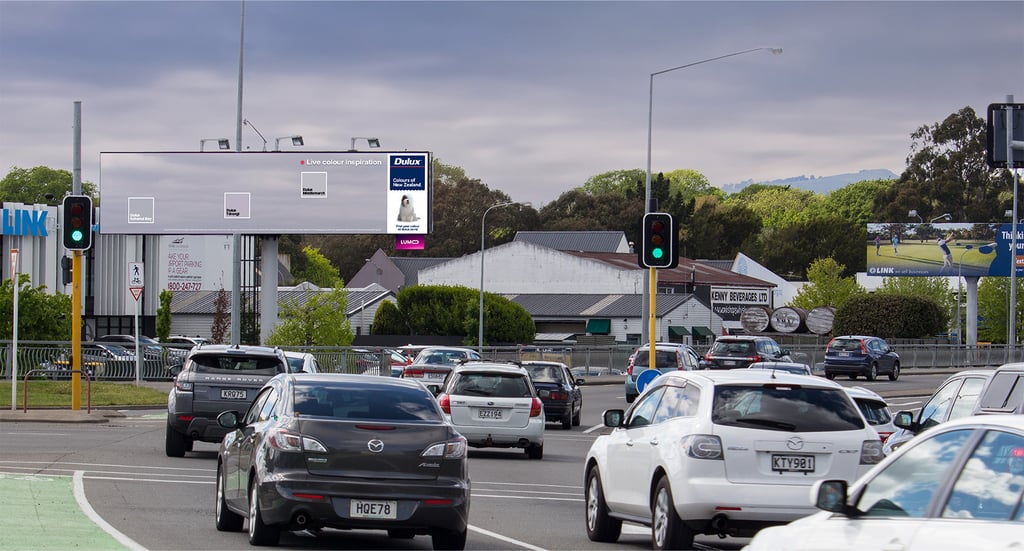
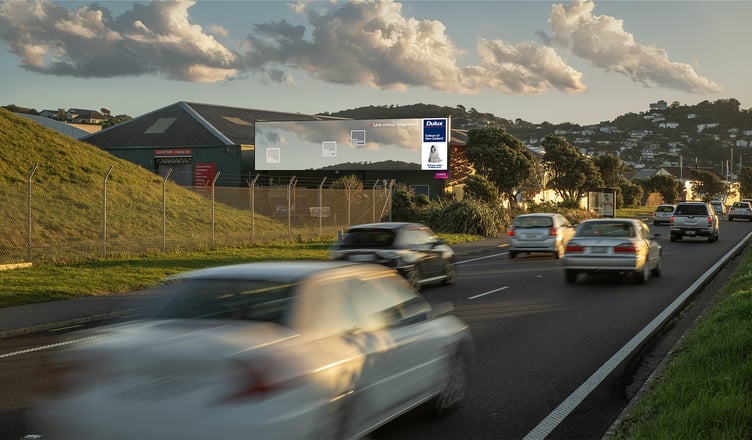
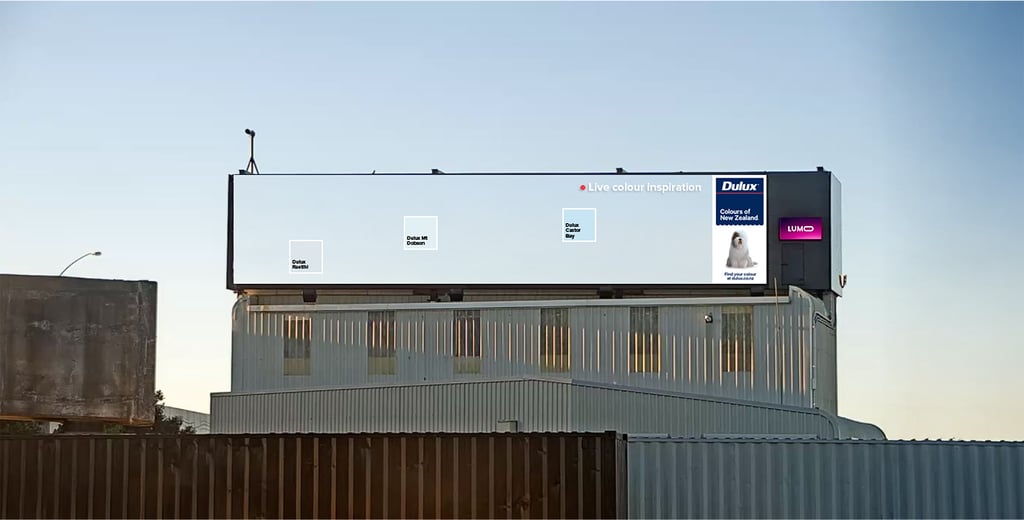
Our work with Dulux approached innovation from a different angle. The challenge wasn’t urgency but inspiration. New Zealanders live among some of the most stunning natural landscapes on Earth, yet their homes had fallen into a beige routine. To reconnect people with the beauty around them, Dulux transformed OOH into live colour swatches. Using real-time camera feeds, digital billboards captured the dominant colours of the local environment and matched them to shades from the “Colours of New Zealand” range.
Every few minutes, the billboards refreshed to reflect what the cameras were seeing, from the blush of a morning sky in Auckland to the deep blues of Wellington’s harbour. It produced a fusion of art, technology and place that redefined how a heritage brand could show up in the modern media mix.
Both campaigns share a fundamental principle: OOH doesn’t have to shout to stand out. It can inform, adapt, and respond in real time, giving brands cultural and contextual presence that no algorithm can replicate.
Performance media – OOH that listens
For years, OOH was considered the top of the funnel, an awareness driver that created mental availability but couldn’t be easily measured or optimised. That perception is now obsolete. As digital infrastructure integrates with outdoor networks, OOH is fast becoming a performance medium.
Programmatic buying allows advertisers to target specific audiences based on time, weather, and location. APIs can feed live information into screens, turning creative into a reflection of the world outside. Mobile ID matching and QR integrations bridge the gap between exposure and action. Together, these shifts mean that OOH can and should operate with the agility of digital and the impact of broadcast.
But the most exciting evolution isn’t just technological, it’s philosophical. This new era of OOH blurs the boundaries between media and environment, between content and context. It asks: what if media didn’t just occupy space, but added to it?
The Dulux and FENZ examples show what happens when OOH is treated not as an ad placement but as a living system. The canvas becomes intelligent, the message adaptive, and the medium participatory. When technology and storytelling intertwine, the result isn’t just attention, it’s interaction.
This redefinition of OOH mirrors the wider trend across media: the move from interruption to integration. People don’t want to be shouted at; they want brands that belong in their world.
A call to boldness
New Zealand’s media landscape has always been defined by creativity out of proportion to its size. Our market is small, our budgets tighter, but our ambition, and our willingness to experiment, is what keeps us globally competitive. The next frontier for that ambition is OOH.
We have the technology, the partners, and the creative talent to push the format further. What’s required now is courage, to see outdoor not as an afterthought but as a first-thought medium for storytelling, innovation, and connection.
OOH is no longer the wallpaper of cities, it’s the digital skin of our shared spaces. When we use it with imagination, it can turn data into dialogue, landscapes into language, and moments into movements.
The challenge for marketers isn’t whether to use OOH – it’s whether they use it with enough boldness.
Because the future of outdoor isn’t fixed. It’s alive, responsive, and waiting for the next idea that proves media can be more than a message.