

I have to hand a lot of points to the team at The Social Collective.
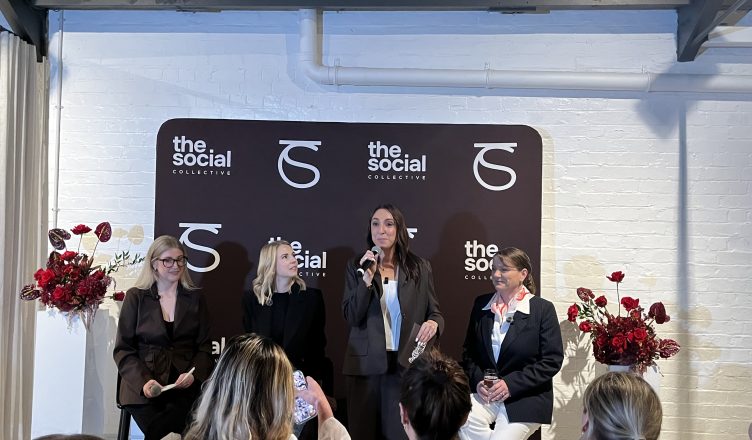
Their Cocktails and Conversations event on August 13 in Tāmaki Makaurau presented an honest look inside the world of AI and the role it can play in business.
Held at the beautiful Tada Studios in the CBD, the event not only ran to schedule with pinpoint accuracy but also featured a delicious range of drinks from Good George and Free AF. And a fun goodie box (which included the latest issue of NZ Marketing magazine).

The panel discussion itself was also packed with interesting insights. Having attended AI conferences galore, I feel like the panellists touched on crucial points that don’t normally get air time.
Sharing knowledge
The Social Collective founder Loren Tomlinson told the gathered crowd of about 70 women that hosting the event was born from her desire to share knowledge. She saw an opportunity to focus on what AI means for the marketing industry and beyond.
Panellists included Tomlinson, Angela March, founder of PR firm Brainchild and The AI Assembly founder Karrina Mountford. Their discussion was hosted by the collective’s senior account manager Morgan Darkwa. It was recorded so it could be turned into an episode of Tomlinson’s podcast Coffee and Content. At the end, the audience was invited to participate in a live Q+A that was not recorded.
You don’t have to be the loudest
March had some good advice on how to get yourself or your brand seen by AI tools.
“Brand visibility and being trust is so important, because people are using AI to make decisions. If you’re not being cited, you’re not being considered,” says March.
“People think to be seen that you have to create lots of content, but it’s actually the opposite.”
Her recommendation is to be clear on the topics you want to be know for, ensure you have the expertise and people to back this up and then seek external validation from other sources like articles and reviews.
“You don’t have to be the loudest, just the easiest to verify,” says March.
She was also quick to remind people who might use AI to make decisions that it doesn’t know everything. She shared an anecdote: asking AI to look up flights to Australia from her home in Hamilton. All the tools she asked recommended heading to Auckland for take-off, neglecting the fact that Hamilton now flies direct to Australia.
March adds that AI is fickle – changing one word in a prompt can completely change the answers you get back, so she urges brands to look for patterns, and still follow SEO best practice. Consistency is also important, so ensure you show up the same way every time. “AI is not good at connecting the dots,” she says.
More human time
Tomlinson shared how AI tools have made her and her team’s workflows more efficient. Reports that used to be built manually in Canva are now being built using Claude Design and Tomlinson’s own email inbox is triaged by Claude.
“Then we can use the time back to review the data and the insights and I’m able to provide the client with a service that is a lot more human-driven even though we’ve implemented more AI,” she says.
She adds that there is never anything that is done “100% with AI” and how important it is that everyone in her business still has oversight over everything.
“We had a time a few weeks ago when we came in, opened our laptops and Claude was down. But we all still know how to do our jobs, so it was fine.”
Knowledge hubs
Mountford’s advice centred on two areas: defining specific use cases of where AI can help you at work and building central knowledge hubs so you’re not putting all of your work into one AI basket.
“Don’t use it willy-nilly, use it for things you actually need it for.”
She reminded the audience that AI doesn’t think, it predicts and so that shifts where it should be deployed.
Mountford suggests creating an AI layer inside the hubs you already use, like Google Drive or Sharepoint. “Create an overarching layer inside it that tells the AI where to go inside those drives,” she says.
She and Tomlinson also discussed the importance of building in a buffer that separates the AI from direct access to your accounts – so that the AI can’t accidentally wipe or create something it shouldn’t.
Causes for concern
All three women also raised causes for concern around privacy risks and data safety. March was adamant that everyone should have an AI policy for their business. Meanwhile, Tomlinson suggested having open conversations with clients and partners about how and what you use it for.
“Hold the space so they feel comfortable to share what their hesitancies are,” she says.
But they also highlighted that despite the inherent risks, they believe there are risks to be had from not using this technology. “There’s a risk to not using it and falling behind,” says Tomlinson. “We can work with it but we don’t have to fear it.”