
As political ad spend shifts to global platforms, local newsrooms doing the journalism keep voters informed, hold politicians to account and build trust, says Calibre + Candor board member Glen Kyne.
As we count down to the next election, I am always interested in the media campaigns. Particularly the allocation of spend and the delivery of trust between the various media platforms.
According to RNZ’s analysis, throughout 2026 up until August 7, when the election-based spend regulation period began, National had spent roughly $114,000 on Facebook and Instagram advertising. That was more than any other party, and its ads were seen close to 19 million times.
In the last election cycle, Act put up to $905,000 into social platforms in the final three months alone. TikTok bans paid political advertising, which means every politician in your feed is there because the algorithm, and not a media buyer, decided you should see them.
Interestingly, political parties have some of the clearest guardrails of all advertisers. They have one product, a hard deadline, a clear outcome and a hard legal cap of $1.503 million (if they contest the party vote) plus $36,000 per electorate candidate.
With these constraints in mind, and the enormous stakes of advertising election spending, it’s not overly surprising that when the parties allocate spend to the platforms (Meta, Google etc), they are also confirming that they believe they are meeting New Zealanders where they are.
So here is my assumption. I’d put it as a fair bet that global platforms take more paid political advertising this cycle than every New Zealand broadcaster and publisher combined.

Reach is one thing. Trust is another.
This is not just a guess, it mirrors an established fact about the wider advertising market. IAB New Zealand puts 2025 digital ad revenue at $2.97 billion, up 12%. That’s 72% of all advertising turnover in this country… and growing. When Newshub closed, I said our industry’s real competitor was never each other, it was always the platforms. If my assumption is right, it proves the point.
However, trust and influence are perhaps what matters most in an election and this is a much closer contest.
AUT Journalism, Media and Democracy Research Centre’s 2026 survey puts social media as the main news source for 19% of New Zealanders. Television is at 20% – effectively a dead heat on attention. Yet only 17% trust the news they find on social platforms. Meanwhile, NZ On Air’s latest Where Are The Audiences research recorded local linear television growing for the first time in years. (I suspect this trend will continue, but that’s a story for another day.)
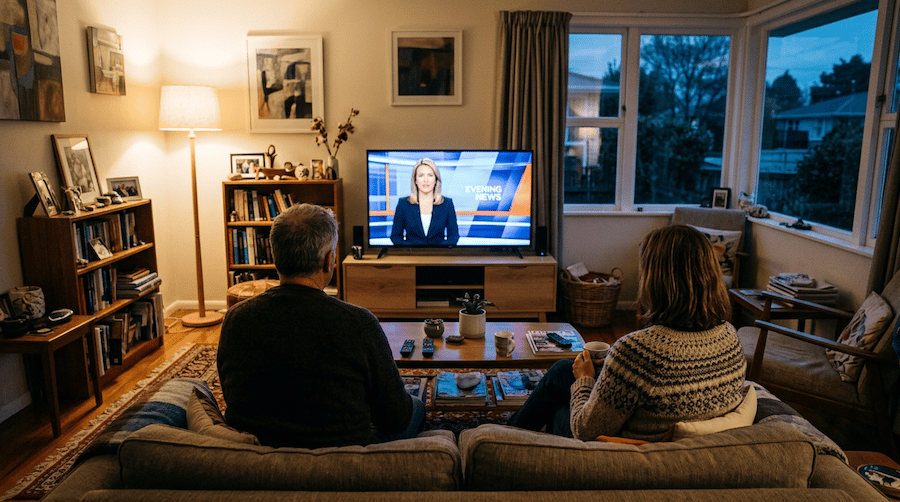
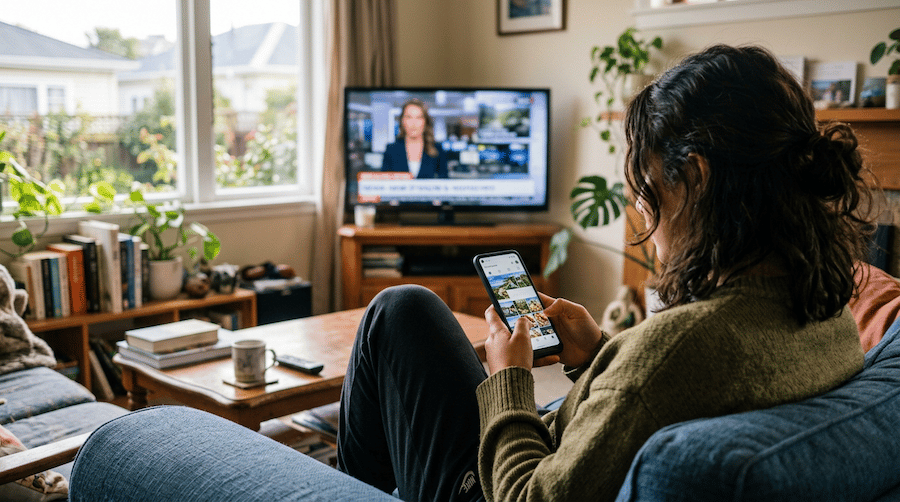
Local linear TV audiences are growing, and trust in traditional news remains stronger than in social media.
Who pays for democracy?
Undecided voters will be influenced and persuaded, I suspect, by a debate they watch, a 6pm bulletin they see or an interview that goes wrong.
Single moment reach and influence of television still sways opinion because of the credibility it brings to its audience.
Many of you may know that the number of journalists in New Zealand has more than halved in a decade. Yet the global platforms accepting paid spend and hosting this campaign employ no journalists and don’t wish to face the same level of scrutiny that keeps local media honest.
On November 7, global platforms will have banked the campaign spend but our newsrooms will have paid for our democracy.
Marketers, advertisers and agencies should all sit with this dilemma. We are buying attention from one side of this ecosystem, yet borrowing trust from the other. The question is what we do when only one side is left to borrow from.