


Above: Rufus Chuter is managing partner at independent media agency Together.
The media migration story appears to be over, according to new research. What comes next is more interesting, says Together’s Rufus Chuter.
For most of the past decade, media planning has been dominated by a migration story.
Audiences were leaving traditional media, streaming was growing, global platforms were winning and fragmentation was accelerating.
But the latest NZ On Air Where Are The Audiences? research – released in August – suggests the picture is becoming a lot more interesting.
After years of disruption, our media landscape appears to be settling down. Broadcast, streaming, social video, audio and gaming increasingly sit alongside one another rather than simply replacing each other. We saw something similar in print. Now video may be reaching its own new equilibrium.
And within that is a particularly useful reminder for marketers: local media and local stories have a value that raw reach numbers do not always capture.
The environment around ads matter
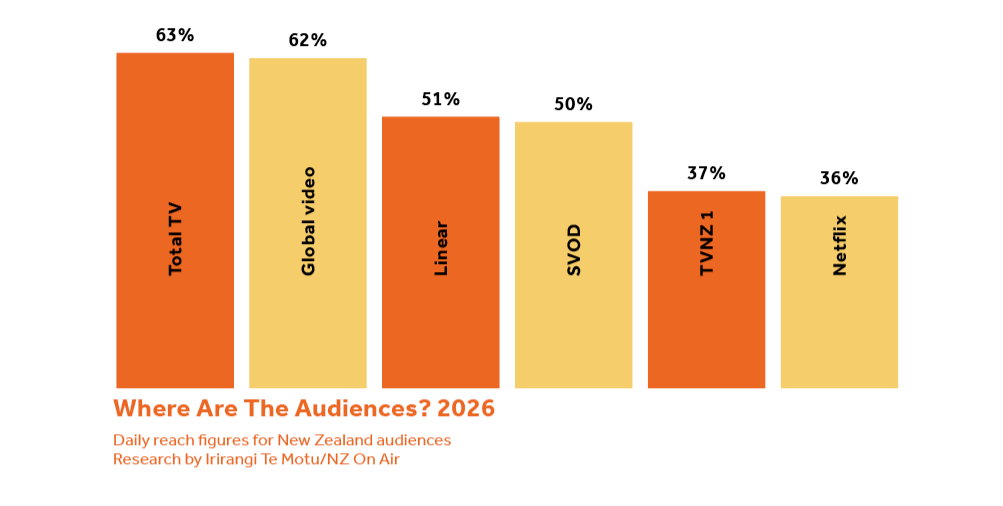
Total TV, which includes linear and NZ BVOD, reaches 63% of New Zealanders every day, compared with 62% for global video platforms. Linear television alone reaches 51%, just ahead of SVOD at 50%.
Perhaps more surprisingly, TVNZ 1 has overtaken Netflix to become the second most-used individual platform in the study. Its daily audience has risen from 32% in 2024 to 37% in 2026, while Netflix has eased from 38% to 36%.
Demographics play a role here. Age splits are notably absent in much of this report, and TV1 famously skews older. Cost plays a role too. Households are becoming more selective about subscriptions. But the report also points to something that can get lost when we reduce media to raw reach and CPMs: New Zealanders like seeing New Zealand reflected back at them.
Overall, 81% say they like seeing New Zealand faces and places in shows. Meanwhile, 71% say NZ shows make them a little prouder to be a New Zealander, while 65% believe our shows are as good as overseas ones. For music, that figure rises to 74%.
For Māori and Pacific audiences, that local connection appears even more important. When asked what makes a programme high quality, these audiences were more likely to mention relatability and local, cultural or New Zealand stories.
None of this should be especially surprising. Good media planners have always known that the environment around an ad matters hugely. Media can provide familiarity, credibility and a sense that a brand belongs in a particular place or community.
It’s also a useful challenge to the idea that reach, and particularly the cheapest possible reach, should dominate every planning decision. At Together, we’ve long believed that media value is broader than cost per audience delivery alone. Modern media demands us to interrogate aspects such as incremental reach, cultural composition, attention, viewing context, shared vs individual viewing, signal transfer, content environment and – of course – ultimate effectiveness.
Those questions will become even more important as media buying becomes increasingly automated and agentic. An agent can find the cheapest impression, but without the right data and strong human judgement it can’t yet “know” which environments will make a brand feel more credible, distinctive or culturally relevant.
Viewers really love local content
Finally, I love that the report challenges another lazy industry narrative: that global and local media compete in a zero-sum game.
People consuming both NZ and global content are frequently even more positive about local content. Among these “dual-engaged” viewers, 84% like seeing NZ faces and places, 68% believe NZ shows are as good as overseas shows and 56% feel NZ shows reflect themselves, their lives and their friends.
That feels much closer to how most of us actually consume media. We don’t wake up and decide to be a Netflix person, a TVNZ person or a YouTube person today. We move between them, choosing the stories, voices and experiences that interest us.
For marketers, understanding what those choices represent and why they matter is where the interesting work begins.

This story is from NZ Marketing magazine issue 88, Sept-Nov 2026. Why not subscribe? Get four issues a year for just $50 (including delivery) if you autorenew.
Essential marketing intelligence. Don’t miss it.