
Every month the Together team highlights five media stories from New Zealand and globally that defined the month, and one great media idea we love. July showed the enduring pulling power of live sport and cinema, while creators, streaming and out of home continued to unlock new opportunities for brands.
TVNZ doubles down on football after World Cup success
In July TVNZ announced that it has secured the exclusive New Zealand rights to the 2030 Fifa Men’s World Cup after its 2026 coverage delivered the biggest event in TVNZ+ history.
More than 20 million streams were recorded across the tournament’s 104 matches. The final between Spain and Argentina attracted 761,000 viewers on TVNZ1, while New Zealand’s three matches reached more than one million broadcast viewers and over half a million on TVNZ+. By the final, one in four New Zealanders had watched some of the tournament.
For marketers, it reinforces the power of free-to-air sport to create genuine national moments while simultaneously delivering viewing scale. It also demonstrates why the battle for live sport rights has become one of the hottest in the local media industry. With the next World Cup spanning several time zones and three continents, the opportunity will extend beyond match spots into highlights, shoulder programming, social content and culturally relevant brand partnerships.
Creator effectiveness: attention is not enough
This month System1 launched their Creator Effectiveness Playbook, which addresses an increasingly important gap: creator content can attract attention without necessarily building the brand behind it.
Based on hundreds of creator ads, the research examines how different creator types generate attention, emotion and branded memory. Its central lesson is that engagement metrics alone are a poor proxy for effectiveness. Creative quality, emotional response and the fit between brand and creator matter more.
System1 chief growth officer Andrew Tindall recently brought the findings to New Zealand following their Cannes Lions debut, offering local marketers a timely reminder to treat creators as a serious creative and brand-building channel, not simply a distribution tactic.
The implication is practical: choose creators for the role they can play, brief for distinctive brand cues and measure whether audiences remember the advertiser, not just whether they watched.
Download the report here: system1group.com/the-creator-effectiveness-playbook
The Odyssey and Spider-Man turn cinema into an event again
July delivered a strong run for New Zealand cinemas. The Odyssey opened with $2.05 million and 97,000 admissions, following the country’s highest admissions week of 2026, when more than 313,000 people visited cinemas.
That momentum accelerated as Spider-Man: Brand New Day opened to $4.45 million at the end of the month, New Zealand’s highest opening since The Lion King in 2019. The Odyssey remained second, taking its cumulative total to $6.39 million.
Is it another Barbenheimer? Not quite. Barbie and Oppenheimer became a participatory cultural double act, while these films are competing rather than complementary. But the broader lesson is similar: distinctive, highly anticipated releases can make cinema-going feel like an event (much like live sport).
For marketers, cinema’s value lies in this combination of attention, cultural relevance and spectacle. July’s record month just reminds us that in our fragmented media world our collective attention can still be captured, and the brands that can surf that collective attention can gain an unfair cultural advantage.
Cupra takes 3D motion to the roadside
New Zealand’s roadside advertising took a major step forward this month, with Lumo (in partnership with Together) launching New Zealand’s first 3D motion roadside billboard campaign for Cupra, using anamorphic creative that appears to extend beyond the screen.
The campaign ran across Lumo’s Auckland network, with each execution custom-built for its site and natural viewing angle. Audience planning combined Lumo’s vehicle intelligence with anonymised mobility data to identify locations carrying higher concentrations of premium automotive audiences.
What makes this significant is the evolution of Lumo’s Subtle movement into 3D. Movement in OOH is far more common in other markets, and so gaining movement in roadside billboards was a major win for marketers; now combining that with attention-grabbing 3D creative only stands to enhance this.
Read more here: nzmarketingmag.co.nz/together-and-lumos-new-cupra-campaign-is-a-3d-billboard-first/
Netflix reveals its New Zealand advertising ambitions
This month Netflix were in market talking to agencies and advertisers about its plans for their ad-supported plan, launching in 2027. Globally, Netflix says its advertising offering now reaches more than 250 million monthly active viewers, with New Zealand among 15 markets joining next year.
The local proposition is expected to include non-skippable advertising, pause ads, sponsorships and partnership opportunities, supported by targeting across genres, individual titles, interests, demographics, geography and viewing context. Netflix is also planning to keep ad loads relatively light, and commit to as much transparency as possible on their audience delivery.
For marketers, this should add a premium, data-rich environment to the New Zealand AV mix – but ad-tier uptake will be key. Lessons will have been learned from their much-publicised miscalculation on ad tier uptake in Australia that saw them offering refunds to advertisers after apparently over-estimating the audience and inventory available. Given the economic climate, our expectation is an ad-funded model will see good uptake and potentially even subscription growth (not just substitution) particularly from students and cost-conscious households.
Media idea we love: Busch’s ‘baleboards‘
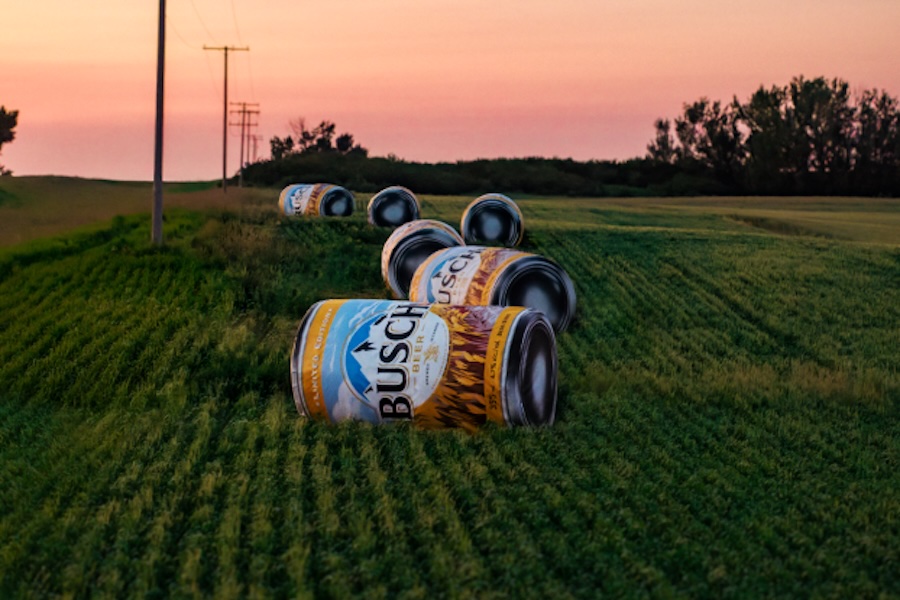
Busch Canada has turned Saskatchewan hay bales into oversized beer cans, creating a new rural media channel on the farms that grow its barley. Participating farmers receive standard billboard rates, moving media money directly into the communities featured in the campaign. We just hope the material is bio-degradable!
Why we love it
- The media is the message. Farmland is not just a backdrop. It is the most authentic possible environment for the brand’s farmer story.
- It creates value locally. Paying growers transforms a branded tribute into a tangible economic contribution.
- It makes the familiar surprising. Ordinary hay bales become distinctive, photographable media assets without losing their connection to place.
A smart reminder that the best new media channels are not always technological. Sometimes they’re already sitting in a field!