
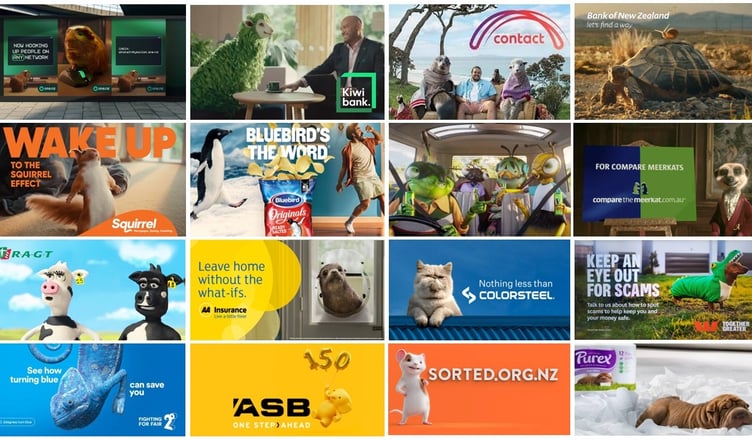
Over the past few months, New Zealand advertising has started looking a little more like a zoo.
Kiwibank has introduced Buck the sheep. One NZ has Simon the guinea pig. The AA has Celia the seal. Contact Energy has assembled its wonderfully odd household of animal flatmates. Westpac has Crocodoggie.
Different brands. Different categories. Different audiences.
Yet together they point towards something that feels bigger than coincidence.
Animal characters are making a comeback.
They’re hardly new. Cookie Bear became one of New Zealand’s best-loved brand icons, disappearing only to return after public outcry. Telecom had Spot the dog. Genesis had Mummy Pukeko. National Bank had its black horses and the PG Tips chimps showed just how enduring a well-crafted animal character could become.
Animals take centre stage
Nor have recurring characters disappeared altogether. Goldstein helped define ASB before Ben and Amy took over. Tina has become inseparable from Turners. The Sharmas have given ANZ a platform that’s been running for years. Time and again, New Zealand’s favourite advertising has been built around familiar faces and ongoing storytelling rather than one-off creative ideas.
What feels different today is that animals are once again taking centre stage.
I don’t think that’s accidental.
My theory is that it’s a response to the environment marketers now find themselves operating in.
Consumers are exposed to thousands of commercial messages every day. Most are seen briefly, once, then forgotten. In that environment, memory becomes one of marketing’s most valuable currencies.
That’s a principle the Ehrenberg-Bass Institute and System1 have championed for years. Brands grow by being easy to notice, easy to recognise and easy to recall. Professor Jenni Romaniuk describes the cues that achieve this as distinctive brand assets – logos, colours, slogans, sounds, packaging and, increasingly, characters.
Unlike campaigns, characters appreciate in value.
Every appearance reinforces memory. Every new story strengthens the association between character and brand. Over time, the character becomes an asset that competitors can’t easily replicate.
The animal advantage
Animals have some unique advantages.
They’re expressive, emotionally disarming and remarkably universal. They cross generations and cultures with ease, allowing brands to inject humour, warmth or personality without the baggage that human celebrities can bring.
Perhaps most importantly, brands own them.
They don’t age or require ongoing talent fees. They don’t change employers. They don’t become tomorrow’s reputational problem. They can appear consistently across television, social media, outdoor, websites and whatever channels emerge next.
That includes AI.
As brands increasingly create conversational experiences, virtual assistants and personalised content, fictional characters become incredibly flexible intellectual property. They can be animated, voiced and adapted almost infinitely while remaining unmistakably the same brand asset.
Whether this recent resurgence proves to be a lasting shift remains to be seen.
A shared marketing challenge
But it seems awfully coincidental that Kiwibank, One NZ, AA, Contact and Westpac all independently landed on a similar creative solution at roughly the same time.
The more plausible explanation is that they’re responding to the same marketing challenge.
In an increasingly fragmented media landscape, brands need assets that build memory year after year, not just campaigns that win attention for a moment.
That’s exactly what great animal characters do.
Perhaps New Zealand advertising isn’t becoming more playful after all.
It’s becoming more distinctive.