


Streaming platforms limit how listeners find and own music. The new Kiwi-made Lume app aims to put the fun back into discovering albums… and more money in artists’ pockets.
Music has always been “it” for Duncan Greive. As a teenager, what little money he had went on records, CDs and music magazines. After becoming a journalist, he went on to edit monthly music magazine Real Groove.
“Basically, my teens and 20s were overwhelmingly obsessed with music,” says Greive. “So music always felt like the foundational place for me.”
It’s only fitting then that after founding digital publication The Spinoff and co-founding creative agency Daylight, he returned to his first love.
In July – with co-founders Tim Harper, Sacha Judd and Justin Warren – he launched Lume. It’s an app that focuses on albums and paying artists fairly.
Why? Streaming platforms couldn’t be the “end game”, say co-CEOs Greive and Harper.
Streaming platforms might have widened access to the music world, but their algorithms also narrow users’ experience of it, says Greive.
“It’s a creative problem: you spend all this time making your album and then it just gets dropped into a giant vat of all the music that’s ever been made.”
These platforms also want artists to produce music at breakneck speed in order to stay relevant, he says. “Streaming has a particular appetite. It wants you to release music at a particular cadence. It didn’t feel like it fit with a lot of artists.”
As touring costs increase, making money as an artist was starting to seem like an impossible task.
“Having worked with artists my whole life and having friends who are artists, we realise how financially challenging it is. They’re all very humble and don’t talk about it too much, but we all know the reality of it,” says Harper. He worked on the Great New Zealand Songbook, released in 2009.


Bonus content
When Greive and Warren came to him with the idea for Lume, Harper immediately thought about all of the content sitting on artists’ hard drives. “There’s an enormous amount of content people don’t see, that fans could really love.”
So they built a way to let that happen. Lume allows artists to upload their albums as well as bonus content like demo recordings, videos and photos. It’s a digital package.
It can be a real mixed bag, but that’s part of the fun. Some artists have the most meticulous filing system, others genuinely forget what they have.
Lume has an arrangement with RNZ, allowing them to access any video or audio featuring an artist, including interviews, podcasts or live show footage.
Users can then buy these digital packages, called Lumes. Harper was surprised to discover the value listeners place on owning files. “So much media has become ephemeral. It’s important to people that they actually own and can have it whenever they want.”
The app costs artists nothing to use and the aim is to return 80% of a Lume’s $24.99 cover price to them.
“The idea is that Lume is for listening to albums and exploring them more deeply. And knowing that you’re meaningfully supporting the artists who created them,” says Greive.
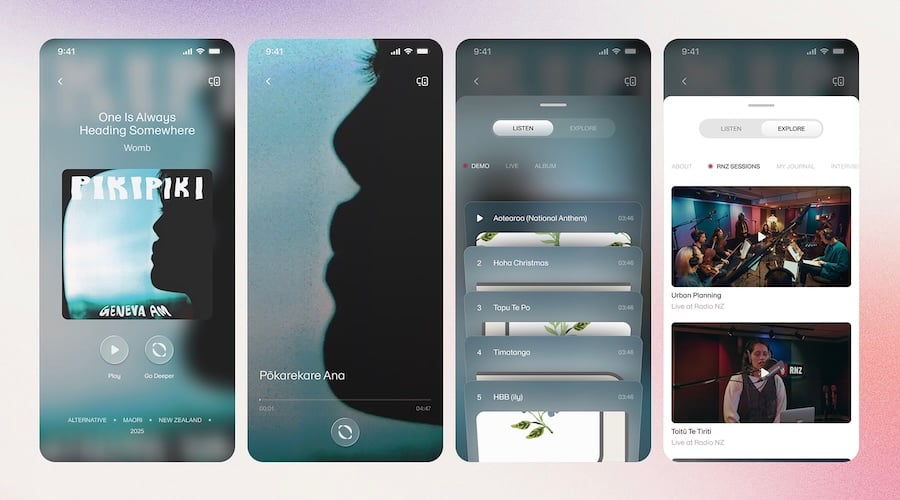

Lume is now live globally on iOS and Android. The initial roster is entirely homegrown – think Fur Patrol, Geneva AM and Troy Kingi. And the project has some big-name Kiwi backers, including Substack’s Hamish McKenzie, Letterboxd’s Karl von Randow and pop star Ella Yelich-O’Connor, aka Lorde.
At the moment, artist and team collaborate in person over several days to create Lumes. As Lume looks to expand internationally, this model isn’t sustainable. But it was the right way to start.
Changing the system
“Sometimes, they’re literally in here scanning their diaries,” says Greive. “It’s a really beautiful way to find out what exists.”
He’s hopeful this process endures to some degree as Lume scales – because no one else understands their musical world like the artists themselves.
The founders sought artists’ feedback at every stage ahead of launch. And the response has been overwhelming.
“All the artists are crying and saying thank you for thinking of us, for trying to do something, for trying to change the system,” says Harper.
Judd is a fandom expert, so fan feedback was also important. This included conducting a survey of 500 people on Billie Eilish’s Discord channel. The responses were “amazingly validating,” says Greive, with people saying they would pay between USD$40 and $50 for a Lume.
For Harper, Lume evokes memories of collecting CDs when he was younger, a joy he wants to pass on.
“CDs and vinyls are one thing, but to have a digital format for digital natives is another. I’m really excited to see my kids discover music properly.”
Like Greive, Harper is also a lifelong music lover: “I look at every photograph of me as a three, four, five-year-old, I’m holding a vinyl. I’m holding a tape, I’m sleeping with it under my pillow.”

This story is from NZ Marketing magazine issue 88, Sept-Nov 2026. Why not subscribe? Get four issues a year for just $50 (including delivery) if you autorenew.
Essential marketing intelligence. Don’t miss it.